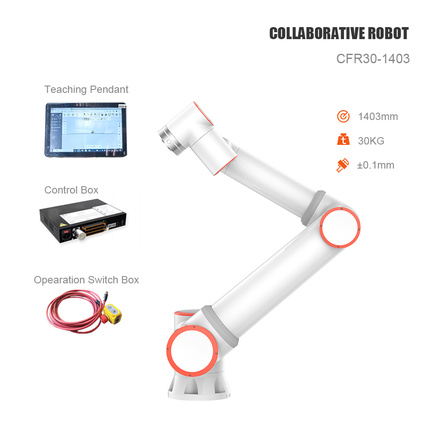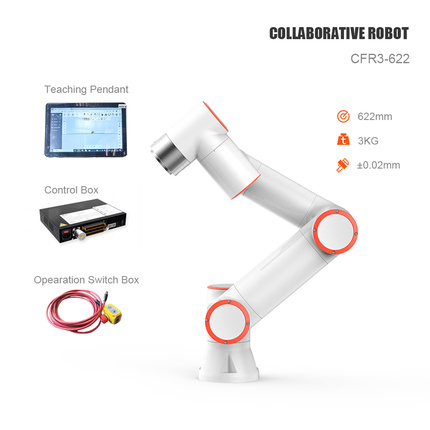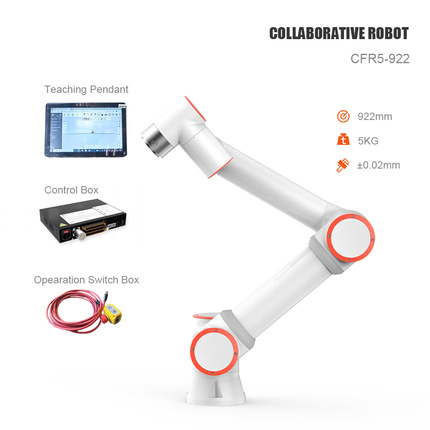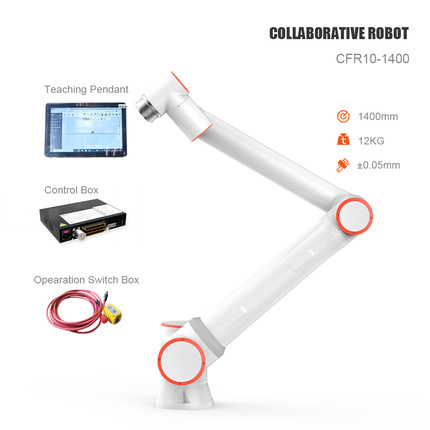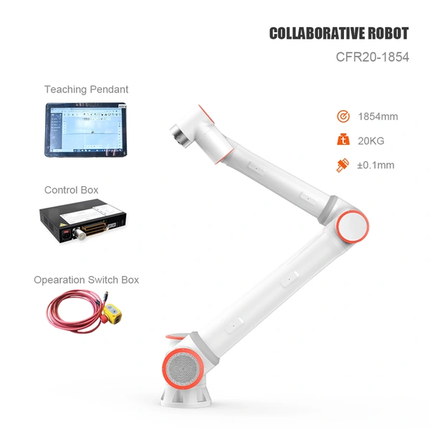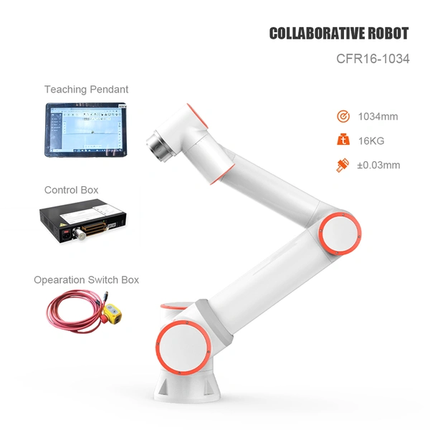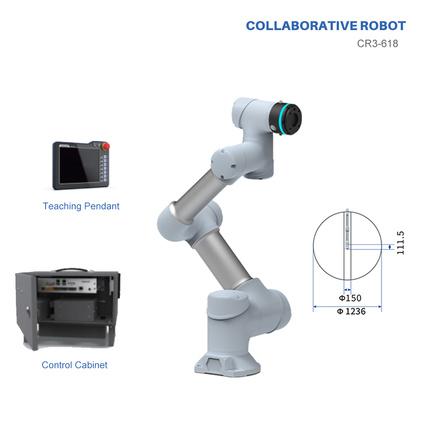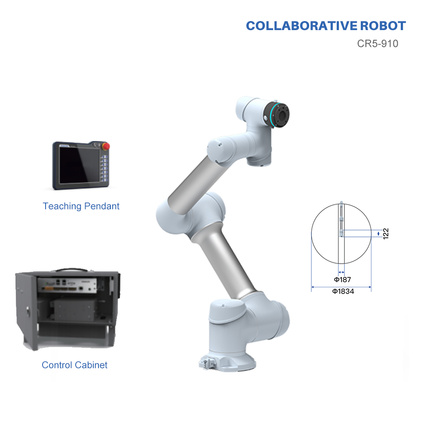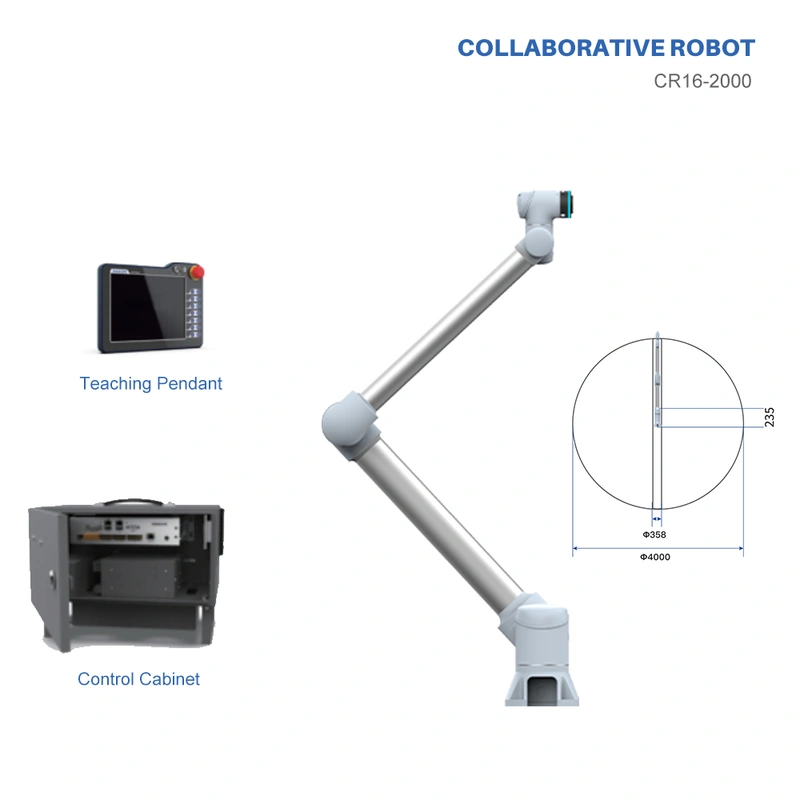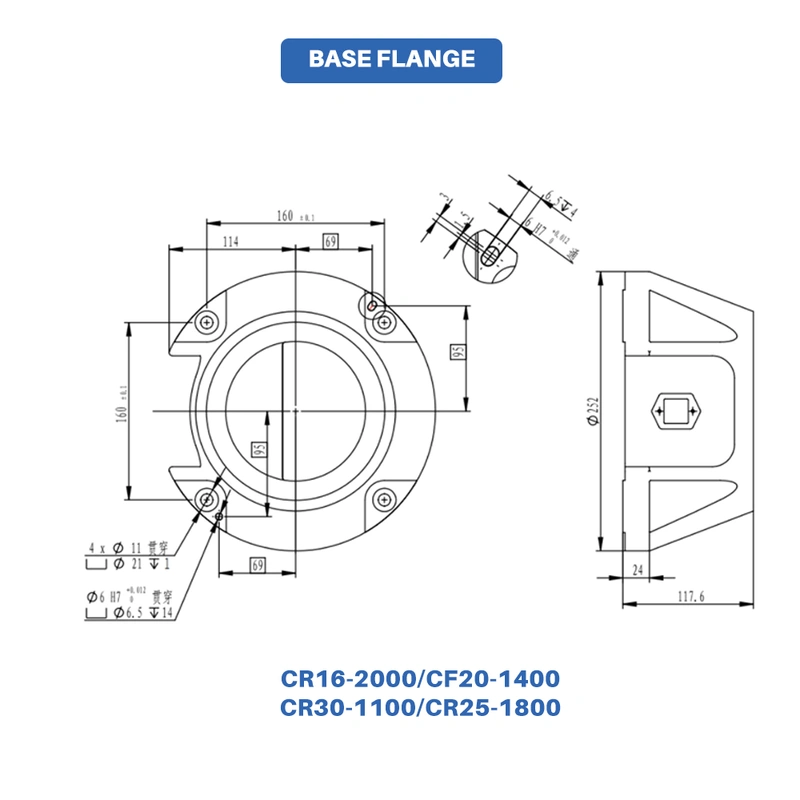















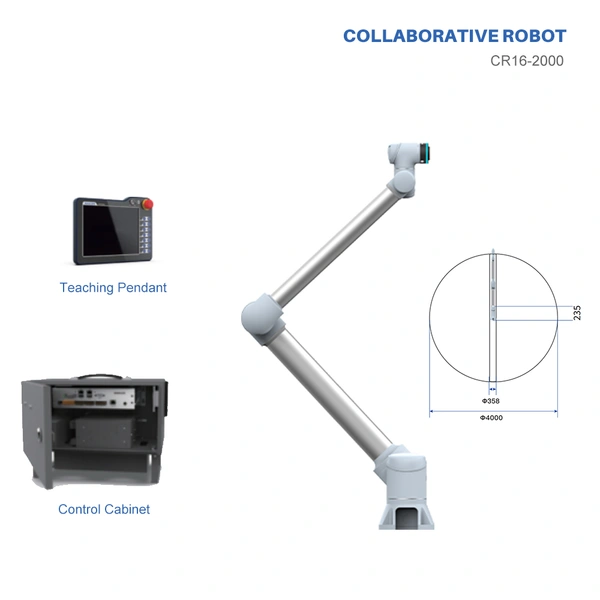
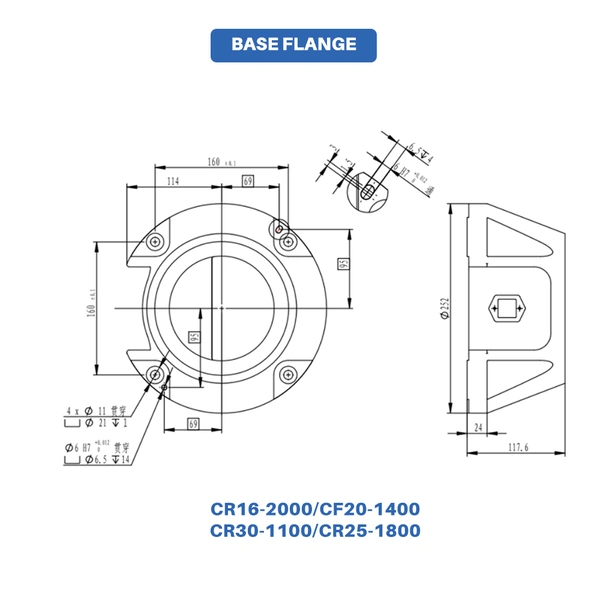



La différence fondamentale entre les robots collaboratifs et les robots industriels traditionnels réside non seulement dans leur apparence ou leur capacité de charge, mais aussi dans leur architecture de contrôle sous-jacente. Les robots collaboratifs utilisent des boucles de contrôle de force/couple, garantissant une sécurité intrinsèque dans les scénarios où humains et robots coexistent.

| Nom | Robot collaboratif de la série CR | ||
| Spécification | Modèle | CR16-2000 | |
| Charge utile | 16 kg | ||
| Atteindre | 2000 mm | ||
| Degrés de liberté | 6 articulations rotatives | ||
| IHM | pupitre de commande de 10,4 pouces ou terminal mobile, application Web | ||
| Mouvement | Répétabilité | ±0,05 mm | |
| Mouvement de l'axe | Plage de travail | Vitesse maximale | |
| 1 axe | ±360° | ±180°/s | |
| 2 axes | ±360° | ±180°/s | |
| 3 axes | ±360° | ±225°/s | |
| 4 axes | ±360° | ±225°/s | |
| 5 axes | ±360° | ±225°/s | |
| 6 axes | ±360° | ±225°/s | |
| Vitesse TCP MAX | 3,5 m/s | ||
| Vitesse maximale en ligne droite | 1,8 m/s | ||
| Caractéristiques | Classification IP | IP54/IP65 | |
| Interface d'outil | GB/T 14468.1-50-4-M6 (équivalent ISO 9409-1) | ||
| Alimentation | 220-240 V CA 47-63 Hz 10 A / 100-200 V CA 47-63 Hz 16 A | ||
| Ports d'E/S | 2 E/S numériques, 24 V, 0,6 A | ||
| Plage de température de stockage | -40℃-55℃ | ||
| Dimensions du robot | 2300 x 388 x 205 mm | ||
| Poids de la machine | 60 kg | ||
| Consommation d'énergie | Consommation électrique typique : 600 W | ||
| Installation | Montage au sol, inversé, en porte-à-faux. Installation possible dans n'importe quelle direction. | ||
| Armoire de commande | Alimentation électrique | 200-240 V CA, 47-63 Hz, 10 A 100-200 V CA, 47-63 Hz, 16 A | |
| Puissance de sortie nominale | 48 V à 600 W | ||
| Poids | 13,6 kg | ||
| Plage de températures de fonctionnement | -10-50℃ | ||
| Plage de température de stockage | -40-55℃ | ||
| Humidité de fonctionnement | 20 % à 70 % HR | ||
| humidité de stockage | 10 % à 95 % (sans condensation) | ||
| Pression atmosphérique | 70-106 kPa | ||
| Classification IP | IP44 | ||
| Bruit | ≤55 dB | ||
| Interface de communication | CAN, RS485, LAN, EtherCAT, INC Encodeur signal lA+, A-; B+, B-; Z+, Z- | ||
| interface utilisateur | 16 entrées numériques (type PNP, L : -3 V~5 V, H : 11 V-30 V CC, 2~15 mA), 16 sorties numériques (type PNP, 22~28 V, Max : 0,5 A) | ||
| Boîtier de commande | Taille de l'écran | 10,4 pouces | |
| Screen Resolution | 800*600/60Hz | ||
| Touchscreen Type | Capacitive | ||
| Operating Temperature Range | 0℃~50℃ | ||
| Operating Humidity Range | 10~90%RH (non-condensing) | ||
| Protection Rating | IP54 | ||
| Dimensions | 295*225*45 (excluding grip) | ||
| Weight | 1.3kg | ||

a. Power and Force Limiting: Built-in torque sensors monitor the torque at each joint in real time, allowing collision force thresholds to be configured below the biomechanical tolerance limits of the human body.
b. Safety-Rated Monitored Stop: Features integrated safety I/O interlocking capabilities.
c. Speed and Separation Monitoring: Enables real-time adjustment of motion speed via a safety PLC.
d. Repeatability: ±0.02 mm
e. Collaborative robots are ideally suited for flexible manufacturing environments characterized by high-mix, variable-batch production—such as laser marking of medical devices, precision assembly, and optical inspection. While maintaining industrial-grade repeatability, they provide a collaborative workspace between humans and machines that is unattainable with traditional robotic systems.
The application value of collaborative robots is based on three major technical pillars: torque control, visual guidance, and flexible deployment. Below, we will comprehensively analyze their application directions from a technical perspective.
I. Precision Assembly and Force Control Technology
Traditional rigid assembly has extremely high requirements for positional accuracy. Even a slight deviation can lead to damage. Collaborative robots adopt a force/position hybrid control method, where the end effector can immediately sense the contact force and actively adapt to it. Typical applications include insertion of electronic connectors and bearing press-fitting. The force control accuracy can reach ±0.5N, and the gap tolerance has been relaxed from 0.01mm to 0.1mm, significantly reducing the requirements for the positioning accuracy of the front end.
II. Surface Treatment and Adaptive Grinding
The workpiece blank has a ±1mm dimensional tolerance, which is difficult for traditional position control robots to handle. The collaborative robot maintains a constant contact force between the tool and the workpiece surface through constant force control, automatically compensates for trajectory deviations, and is suitable for scenarios such as grinding of car bumpers, polishing of bathroom hardware, and sanding of wood products.
III. Machine Vision Guidance and Zero-Teaching Grasping
The collaborative robot equipped with 2D/3D cameras achieves visual servoing through hand-eye calibration. The deep learning model can identify the pose of scattered and stacked workpieces and plan the grasping trajectory in real time. During product changeover, only the visual model needs to be switched, reducing the programming time from several hours to minutes. It can also be used for quality control tasks such as product appearance inspection, size measurement, and OCR character recognition.
IV. Mobile Collaborative Composite Robot
Le bras collaboratif est monté sur le châssis de l'AMR pour former un système intégré « main-œil-pied ». Il est adapté aux opérations de manutention et d'usinage entre différents postes de travail, comme sur une ligne d'usinage automatisée : l'AMR se déplace vers la machine CNC, le bras mécanique saisit la pièce brute et l'alimente en broche, puis, une fois l'usinage terminé, le produit fini est extrait et envoyé au poste de contrôle. La communication utilise la technologie 5G + OPC UA pour une collaboration à la milliseconde près.
V. Post-traitement du traitement laser et de la fabrication additive
Les robots collaboratifs fonctionnent de concert avec les équipements laser pour réaliser des opérations de découpe, de soudage, de marquage et de nettoyage. Dans le domaine des dispositifs médicaux, des robots collaboratifs de haute précision sont utilisés pour le marquage laser des codes UDI ; en post-traitement de l’impression 3D, ils servent à l’élimination des supports et à la finition de surface.
VI. Palettisation, dépalettisation et emballage
Les robots collaboratifs sont adaptés aux opérations de palettisation et de dépalettisation dans divers entrepôts logistiques et en fin de ligne de production. Ils peuvent identifier automatiquement les cartons de différentes tailles et les empiler selon des schémas prédéfinis, remplaçant ainsi les tâches de manutention manuelle lourde et réduisant les risques d'accidents du travail.
L'évolution technologique des robots collaboratifs, passant des « actions répétitives à des positions fixes » à « l'adaptabilité environnementale et aux tâches diversifiées », leur a permis de répondre à divers scénarios d'application, apportant un grand confort.