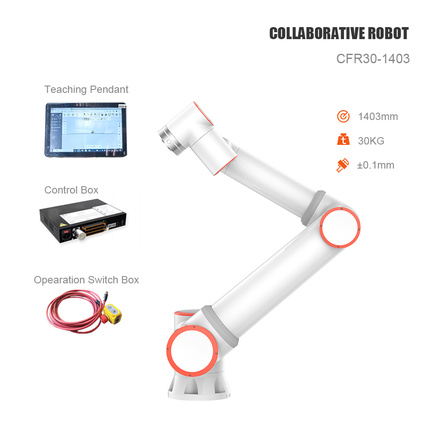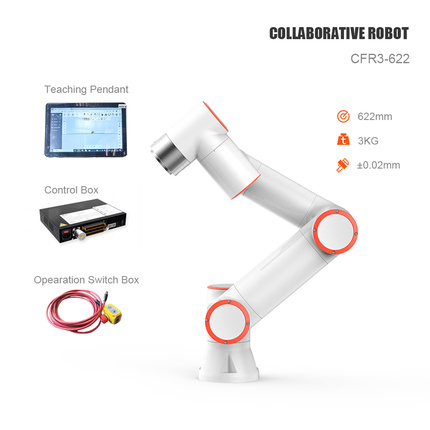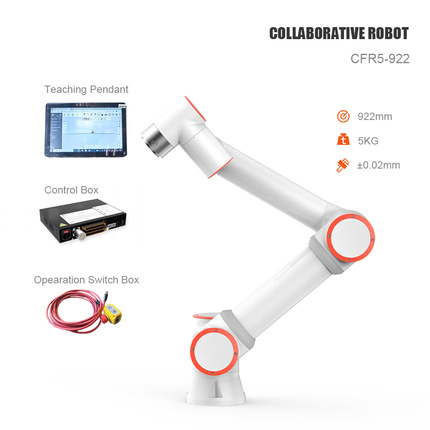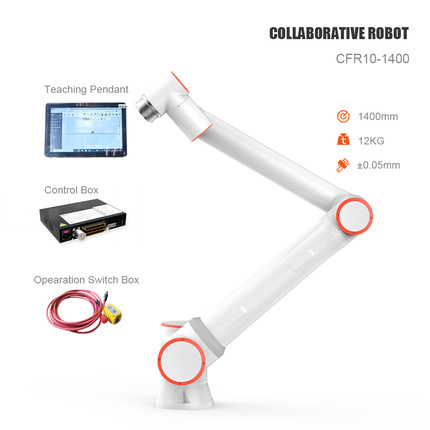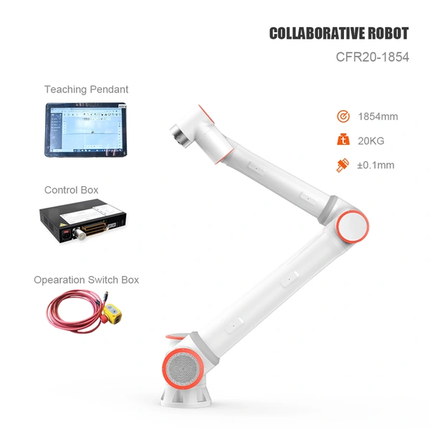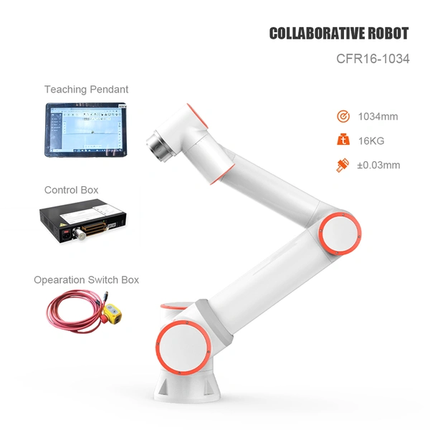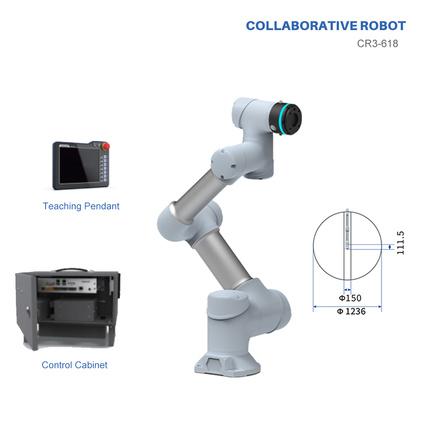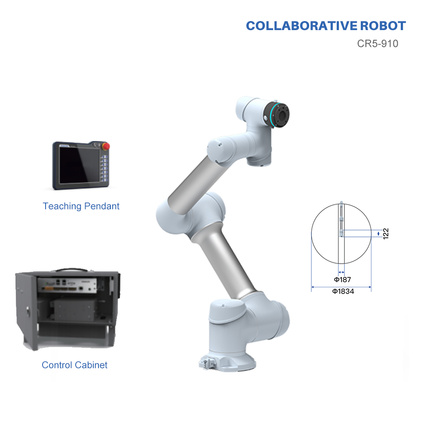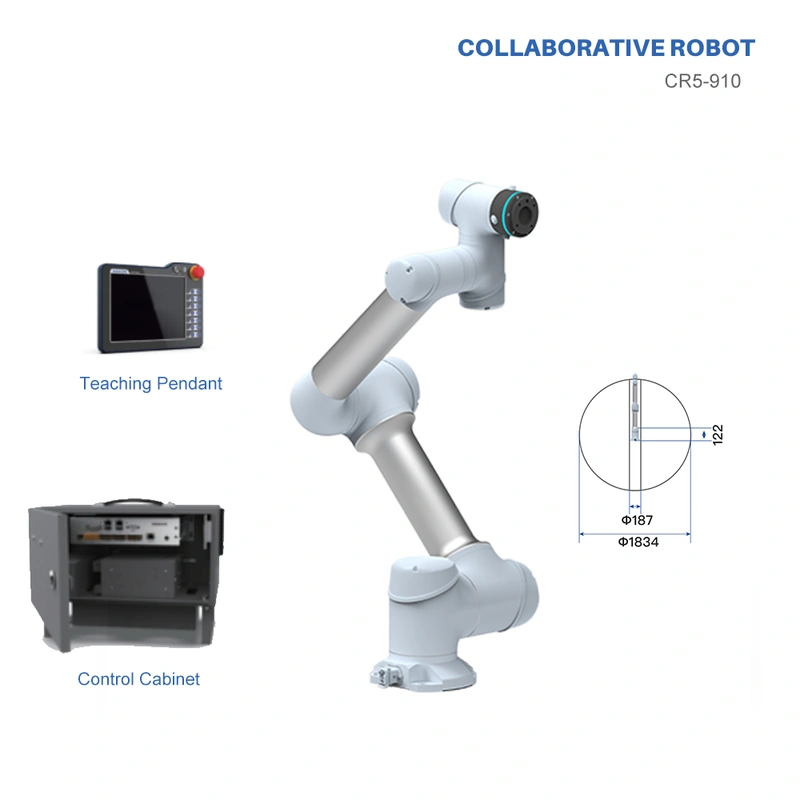















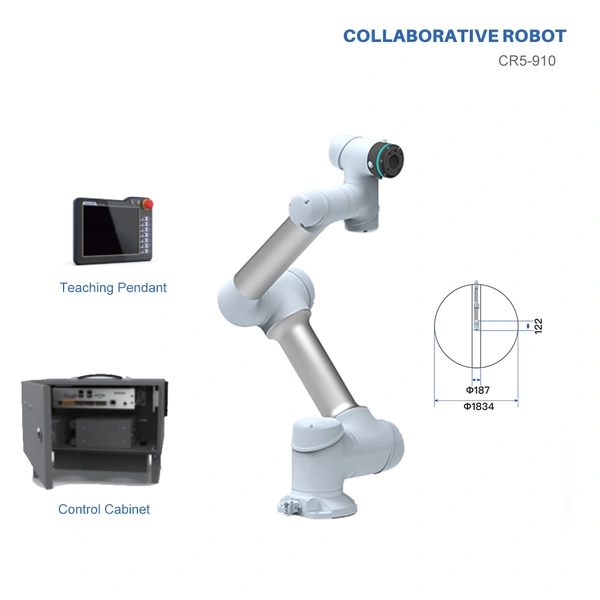



Les robots collaboratifs sont spécifiquement conçus pour interagir directement et de près avec les humains au sein d'un espace de travail partagé. C'est ce qui les distingue fondamentalement des robots industriels traditionnels : alors que ces derniers doivent être physiquement isolés – généralement derrière des barrières de sécurité – pour des raisons de sécurité, les robots collaboratifs peuvent travailler aux côtés des travailleurs humains sans nécessiter de barrières physiques.

| Nom | Robot collaboratif de la série CR | ||
| Spécification | Modèle | CR5-910 | |
| Charge utile | 5 kg | ||
| Atteindre | 917 mm | ||
| Degrés de liberté | 6 articulations rotatives | ||
| IHM | pupitre de commande de 10,4 pouces ou terminal mobile, application Web | ||
| Mouvement | Répétabilité | ±0,02 mm | |
| Mouvement de l'axe | Plage de travail | Vitesse maximale | |
| 1 axe | ±360° | ±225°/s | |
| 2 axes | ±360° | ±225°/s | |
| 3 axes | ±360° | ±225°/s | |
| 4 axes | ±360° | ±225°/s | |
| 5 axes | ±360° | ±225°/s | |
| 6 axes | ±360° | ±225°/s | |
| Vitesse TCP MAX | 3,6 m/s | ||
| Vitesse maximale en ligne droite | 1,5 m/s | ||
| Caractéristiques | Classification IP | IP54/IP65 | |
| Interface d'outil | GB/T 14468.1-50-4-M6 (équivalent ISO 9409-1) | ||
| Alimentation | 220-240 V CA 47-63 Hz 10 A / 100-200 V CA 47-63 Hz 16 A | ||
| Ports d'E/S | 2 E/S numériques, 24 V, 0,6 A | ||
| Plage de température de stockage | -40℃-55℃ | ||
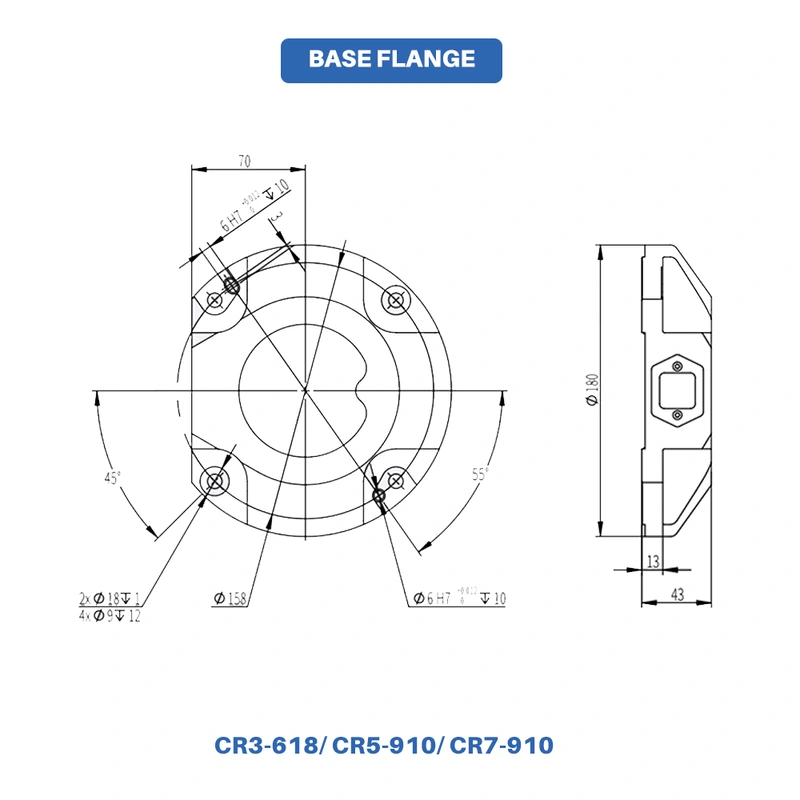
| Dimensions du robot | 1100 x 330 x 220 mm | ||
| Poids de la machine | 22 kg | ||
| Consommation d'énergie | Consommation électrique typique : 200 W | ||
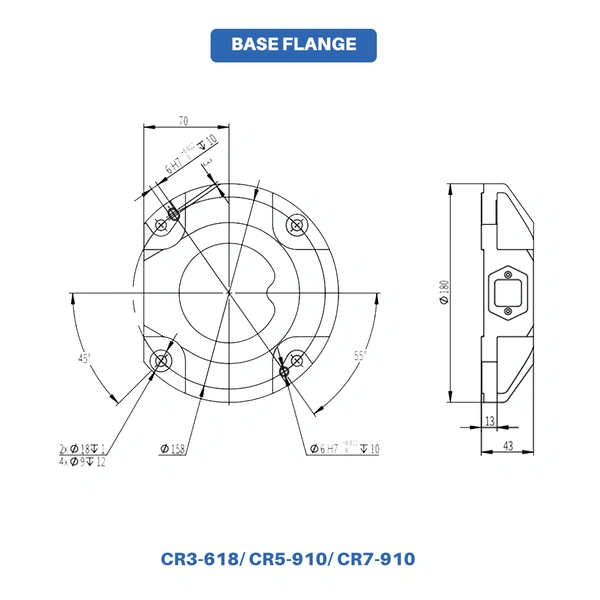
| Installation | Montage au sol, inversé, en porte-à-faux. Installation possible dans n'importe quelle direction. | ||
| Armoire de commande | Alimentation électrique | 200-240 V CA, 47-63 Hz, 10 A 100-200 V CA, 47-63 Hz, 16 A | |
| Puissance de sortie nominale | 48 V à 600 W | ||
| Poids | 13,6 kg | ||
| Plage de températures de fonctionnement | -10-50℃ | ||
| Plage de température de stockage | -40-55℃ | ||
| Humidité de fonctionnement | 20 % à 70 % HR | ||
| humidité de stockage | 10 % à 95 % (sans condensation) | ||
| Pression atmosphérique | 70-106 kPa | ||
| Classification IP | IP44 | ||
| Bruit | ≤55 dB | ||
| Interface de communication | CAN, RS485, LAN, EtherCAT, INC Encodeur signal lA+, A-; B+, B-; Z+, Z- | ||
| interface utilisateur | 16 entrées numériques (type PNP, L : -3 V~5 V, H : 11 V-30 V CC, 2~15 mA), 16 sorties numériques (type PNP, 22~28 V, Max : 0,5 A) | ||
| Boîtier de commande | Taille de l'écran | 10,4 pouces | |
| Résolution d'écran | 800*600/60Hz | ||
| Type à écran tactile | capacitif | ||
| Plage de températures de fonctionnement | 0℃~50℃ | ||
| Plage d'humidité de fonctionnement | 10 à 90 % HR (sans condensation) | ||
| Indice de protection | IP54 | ||
| Dimensions | 295*225*45 (poignée exclue) | ||
| Poids | 1,3 kg | ||

a. Limitation de la puissance et de la force : des capteurs de couple intégrés surveillent le couple à chaque articulation en temps réel, permettant de configurer les seuils de force de collision en dessous des limites de tolérance biomécaniques du corps humain.
b. Arrêt surveillé homologué pour la sécurité : intègre des capacités de verrouillage E/S de sécurité.
c. Surveillance de la vitesse et de la séparation : Permet un réglage en temps réel de la vitesse de déplacement via un automate programmable de sécurité.
d. Répétabilité : ±0,02 mm
e. Collaborative robots are ideally suited for flexible manufacturing environments characterized by high-mix, variable-batch production—such as laser marking of medical devices, precision assembly, and optical inspection. While maintaining industrial-grade repeatability, they provide a collaborative workspace between humans and machines that is unattainable with traditional robotic systems.
The application value of collaborative robots stems from their three key technical features: force control perception, visual guidance, and flexible deployment. Below, we analyze four core application directions from the perspective of technical implementation.
1. Precise Assembly and Force Control Insertion
In traditional rigid assembly, positional deviations can lead to jamming or damage to the workpiece. Collaborative robots adopt a torque control mode, allowing the end to promptly sense contact force and actively adapt. A typical application is the insertion of electronic connectors: The robot initially applies a force of 0.5N to search for the hole position. Upon detecting a sudden change in force, it automatically adjusts its posture to achieve a precise insertion with a gap of 0.1mm, resulting in a yield rate of up to 99.9%.
II. Adaptive Grinding and Polishing
The workpiece blank has a ±1mm dimensional tolerance. Traditional position control robots are difficult to adapt to this. Collaborative robots use a force/position hybrid control method to maintain a constant contact force between the end tool and the workpiece surface (with an accuracy of ±0.5N), automatically compensating for trajectory deviations. It is suitable for surface treatment of automotive parts, bathroom hardware, and other products.
III. Machine Vision Guided Grasping
The collaborative robot equipped with 2D/3D cameras achieves visual servoing through hand-eye calibration. A typical application is the sorting of scattered and stacked workpieces: the deep learning model identifies the position and orientation of the workpieces, and the robot plans the grasping trajectory in real time. No precise positioning of the tray is required. During production changeovers, only the visual model needs to be switched, and the programming time is compressed from several hours to minutes.
IV. Mobile Collaborative Composite Robot
The collaborative arm is mounted on the AMR chassis to form an integrated "hand-eye-foot" system. It is suitable for cross-workstation material handling and operation scenarios, such as in a machining production line: The AMR moves to the lathe, the mechanical arm grabs the blank and feeds it into the spindle, and after completion, the finished product is taken out and sent to the inspection station. Communication is achieved through 5G + OPC UA, with millisecond-level collaboration.
Les quatre directions ci-dessus représentent le chemin par lequel les robots collaboratifs évoluent des « actions répétitives d'un poste de travail fixe » à « l'adaptabilité environnementale et aux tâches diversifiées ».