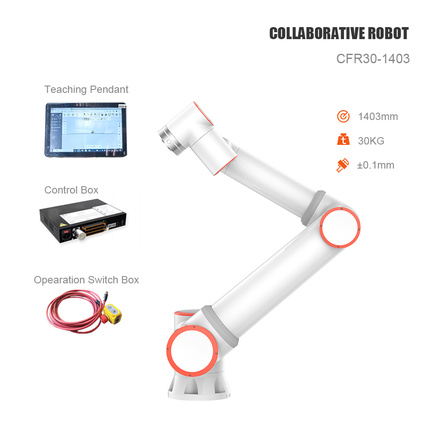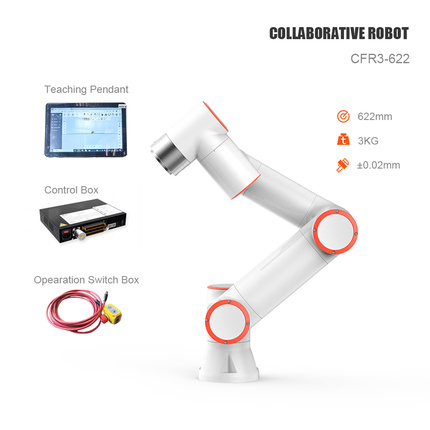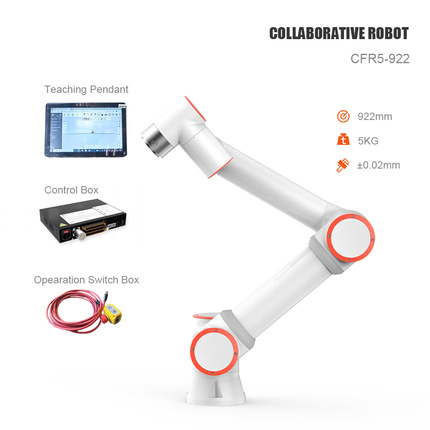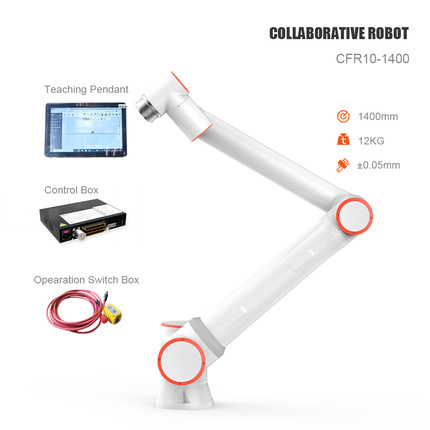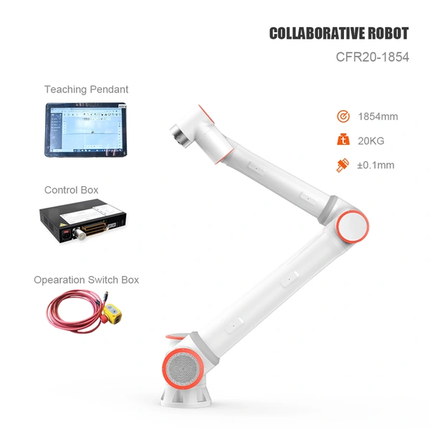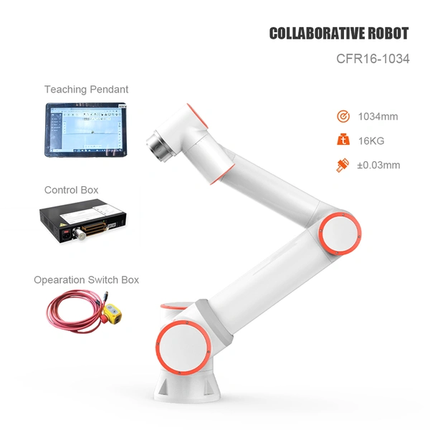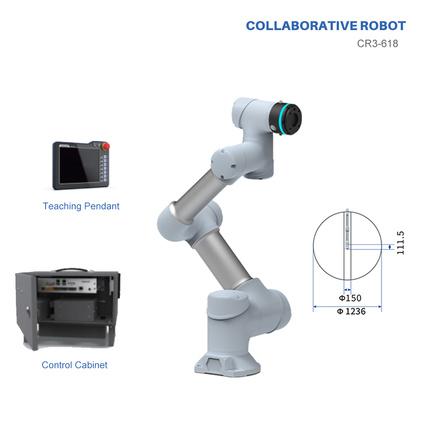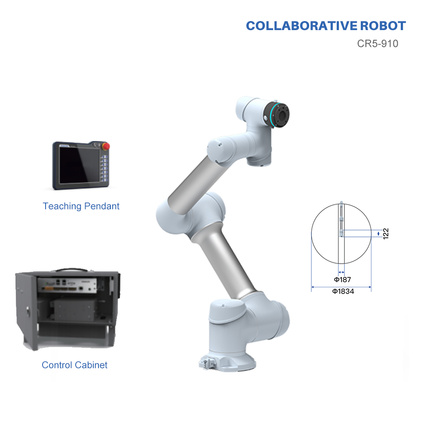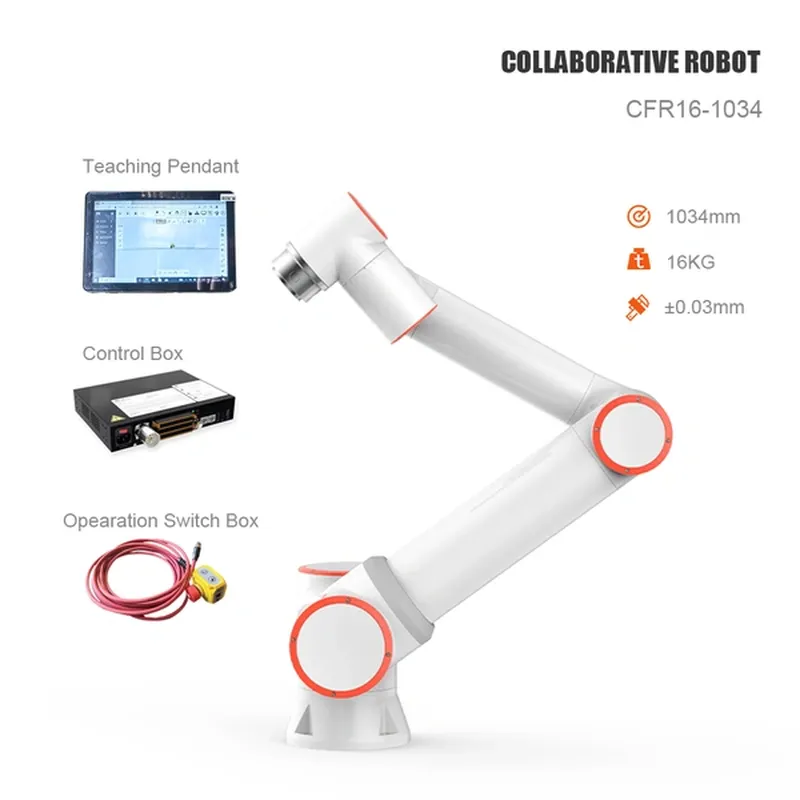















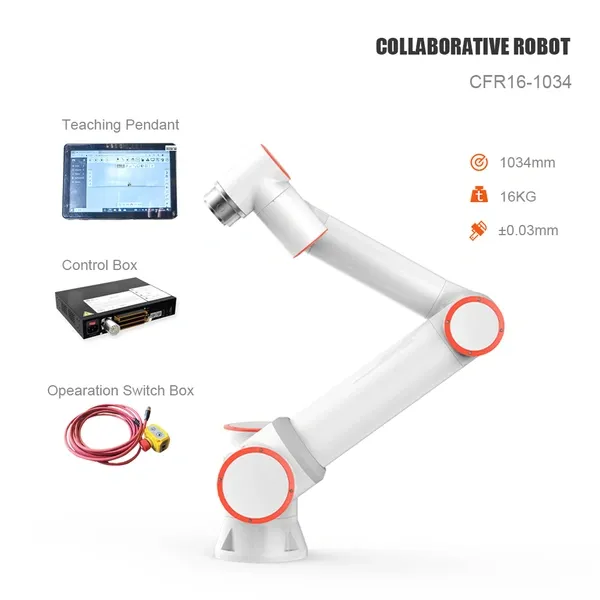

협동 로봇은 동일한 작업 공간에서 인간과 안전하게 협업하도록 특별히 설계된 지능형 로봇 장치입니다. 안전 장벽을 통한 물리적 격리가 필요한 기존 산업용 로봇과 달리, 내장된 힘 센서, 충돌 감지 기능, 경량 설계 등을 갖춘 협동 로봇은 물리적 분리 없이 작업자와 나란히 작업할 수 있습니다.

| 이름 | 지능형 협업 로봇 | ||
| 사양 | 모델 | CFR16-1034 | |
| 유효 탑재량 | 16kg | ||
| 도달하다 | 1034mm | ||
| 자유도 | 6개의 회전 관절 | ||
| HMI | 10.1인치 티치 펜던트 또는 모바일 단말기 웹 앱 | ||
| 움직임 | 반복성 | ±0.03mm | |
| ISO 9283에 따른 자세 반복성 | ±0.03mm | ||
| 축 이동 | 작동 범위 | 최대 속도 | |
| 1축 | ±175° | ±120°/s | |
| 2축 | ﹢85°/﹣265° | ±120°/s | |
| 3축 | ±160° | ±180°/s | |
| 4축 | ﹢85°/﹣265° | ±180°/s | |
| 5축 | ±175° | ±180°/s | |
| 6축 | ±175° | ±180°/s | |
| 일반적인 TCP 속도 | 1m/s | ||
| 특징 | IP 분류 | IP54(IP65 선택 사항) | |
| 소음 | <65db | ||
| 로봇 장착 | 어떤 방향이든 | ||
| 입출력 포트 | 디지털 입력(DI) 2개, 디지털 출력(DO) 2개, 아날로그 입력(AI) 2개, 아날로그 출력(AO) 2개, 고속 펄스 입력 2개 | ||
| 툴 I/O 전원 공급 장치 | 24V/1.5A | ||
| 물리적 | 발자국 | 190mm | |
| 무게 | 40kg(와이어 제외 무게) | ||
| 작동 온도 | 0~45℃ | ||
| 작동 습도 | 습도 90%(비응축) | ||
| 재료 | 알루미늄, 강철 | ||
| 평균 전력 | 310와트 | ||
| 제어 상자 | 표준 통신 | 입출력, TCP/IP, Modbus_TCP/RTU | |
| 선택적 통신 | CC-Link, Profinet, Ethernet/IP, EtherCAT | ||
| 소프트웨어 개발 키트 | C#/C++/파이썬/ROS/ROS2 | ||
| L*W*H | 245*180*44.5mm | ||
| 무게 | 2.1kg | ||
| 재료 | 아연 도금 강판 | ||
| 전원 공급 장치 | 30-60VDC | ||
| 기계어 | 영어, 중국어, 러시아어, 한국어, 일본어, 프랑스어 등 다양한 언어로 맞춤 설정이 가능합니다. | ||

6축 협동 로봇은 소형 부품 취급, 조립, 집어 올리기 및 놓기 등에 특화되어 설계되었습니다. 이 협동 로봇은 내장된 토크 및 안전 센서 덕분에 작업자와 함께 작업하는 동안 안전을 유지할 수 있습니다.
이 제품은 3kg의 하중을 견딜 수 있으며 경량으로 설계되어 전자 조립, 소형 부품 분류, 경량 기계 조작 및 품질 검사 등 다양한 작업에 적합합니다.
이 협동 로봇을 선택해야 하는 이유는 무엇일까요?
1. 안전한 인간-기계 협업내장된 안전 센서는 접촉 상황을 감지하여 로봇 팔을 즉시 정지시킬 수 있습니다.
안전 난간이 필요 없어 공장 바닥 공간과 설치 비용을 절약할 수 있습니다.
ISO 10218 안전 기준을 준수합니다.
2. 사용이 매우 간편합니다Drag-and-drop teaching programming: hold the arm and guide it to complete the action
No programming background required - an employee can learn to operate it in less than an hour.
A graphical interface is provided to handle more complex sequences.
3. Lightweight and portableWeighs only [15 kilograms] - one person can carry and re-deploy it
No special foundation or heavy installation fixtures required
Can move work positions between various work areas according to production demand changes
4. Precision requirements for small parts±0.02 millimeters of repeatability error ensures precise placement of tiny components.
The six-axis freedom allows for any-angle operation - perfect for use in narrow spaces
5. Quick return on investmentReplace repetitive manual work with automation technology
7X24 hours operation capability
Typical investment payback period: 6 to 12 months

Collaborative robots are widely used in precise assembly and screw fastening, especially in the 3C electronics and automotive parts industries. With a high-precision force control system, collaborative robots can achieve accurate torque control during screw fastening and flexible wiring cable insertion, avoiding product damage caused by improper force. In automotive parts assembly, flexible mechanical arms can flexibly adapt to the assembly requirements of different model components, effectively improving production efficiency and assembly quality.
2. WeldingCollaborative robots are rapidly penetrating industries with high demands for flexible welding, such as steel structures and ships. Through dragging teaching and graphical programming, collaborative robots can quickly switch welding parameters and process paths, solving the problems of complex debugging and high costs in traditional welding equipment in small batch production. UJIAN Technology's "Steel Tailor" intelligent welding robot can autonomously identify weld seams, plan paths, and adjust parameters in real time.
3. PalletizingThe growth of the palletizing application market is mainly driven by the two major industries of food and beverage and chemical products. The post-packaging process of small and medium-sized food and beverage and daily chemical enterprises mostly still uses manual handling, resulting in low efficiency and rising labor costs. Collaborative palletizing robots have better solved these problems, achieving automated flexible palletizing, and the market is growing rapidly.
4. Material Handling and Loading and UnloadingCollaborative robots can cooperate with CNC machines, injection molding machines, etc., to achieve automated loading and unloading, reducing the labor intensity of manual work. In the electronics production line, collaborative robots can save waiting time at workstations by using dual gripper positions and improve production efficiency. For example, after a collaborative robot grabs a component from secondary injection molding, it is sent to the cutting board and automatically cycles, requiring only one operator per shift, and the production capacity can be increased by three times.
5. Inspection and Quality MonitoringCombined with machine vision technology, collaborative robots can perform product appearance inspection, size measurement, etc., improving the quality control level. In PCB circuit board inspection, collaborative robots are equipped with structured light systems to accurately detect micro cracks, bent pins, etc., and record each inspection data to achieve quality traceability.
6. Grinding and PolishingCollaborative robots, with their flexible deployment and human-machine collaboration characteristics, are gradually overcoming the pain points of low efficiency and large dust hazards in traditional grinding operations. In fine grinding of 3C product appearance parts and surface treatment of automotive parts in specific scenarios, their application potential is huge.
7. PaintingWith the launch of explosion-proof collaborative robots, the application of collaborative robots has gradually expanded to painting work in high-temperature and high-risk environments, and its recognition in the painting field has increased due to its high sealing and dust-proof characteristics.
Non-Industrial Applications1. Medical and Laboratory AutomationSurgical assistance: Collaborative robots can assist doctors in performing minimally invasive surgeries, improving operation stability and accuracy.
Rehabilitation training: In rehabilitation medicine, collaborative robots can help patients perform limb movement training to promote functional recovery.
Laboratory automation: Collaborative robots can be used for sample sorting, tube transportation, and experimental operations, improving laboratory efficiency and reducing the risk of human contamination. In diagnostic laboratories, collaborative robots handle samples in clean rooms without rest, contamination, or errors.
2. Logistics and WarehousingWarehouse handling: Collaborative robots can be combined with AGVs to achieve automatic handling and stacking of goods.
Order sorting and packaging: In e-commerce logistics centers, collaborative robots can quickly identify and sort goods and complete automated packaging. For example, Vention's collaborative robots can fold 5-7 boxes per minute, accurately completing the packing.
3. Catering and Retail스마트 커피 워크스테이션: 표준화된 로봇 팔 제어 시스템을 탑재하여 일반적인 커피 추출 과정뿐만 아니라 사용자의 선호도에 따라 추출 시간과 우유 거품 비율을 맞춤 설정할 수 있습니다.
식품 준비: 협동 로봇은 케이크 장식, 식품 포장 등에 활용될 수 있습니다. 크림 프로스팅부터 초밥 만들기까지, 협동 로봇은 식품 등급 안전 기준에 맞춰 정밀한 장식과 포장을 완성합니다.
4. 비즈니스 서비스스마트 마사지 워크스테이션: 표준화된 기계식 전달 및 압력 피드백 모듈을 사용자의 체형 데이터와 결합하여 개인 맞춤형 마사지 계획을 제공합니다.
안내 및 고객 서비스: 일부 협동 로봇은 음성 상호 작용 및 내비게이션 기능을 갖추고 있어 쇼핑몰, 공항 등에서 안내 및 상담 서비스를 제공하는 데 활용될 수 있습니다.
5. 농업협동 로봇은 과일과 채소 수확 및 온실 관리에 활용되어 농업 생산의 자동화 수준을 향상시킬 수 있습니다.
6. 기타 신흥 산업에너지: 위험한 환경에서 장비 검사 및 유지보수를 지원하여 인력 안전을 확보합니다.
교육: 교육 도구로서, 로봇은 학생과 연구자들이 로봇 프로그래밍 및 응용 기술을 배우는 데 도움을 줍니다.