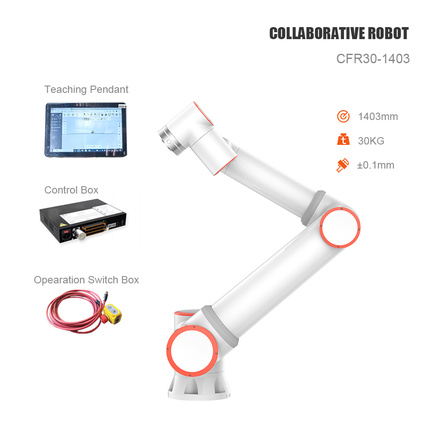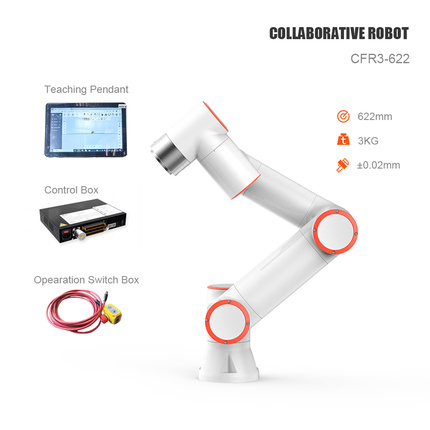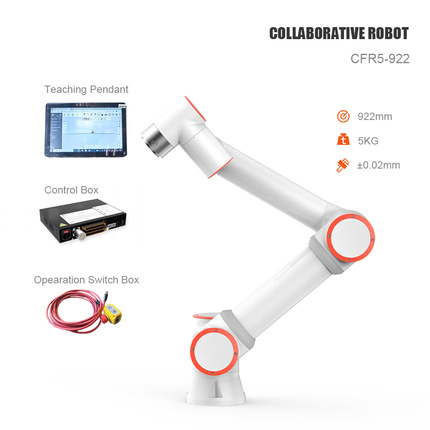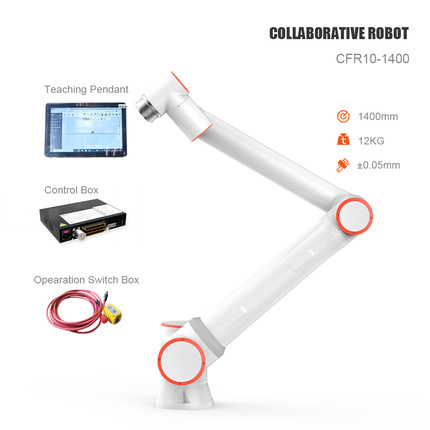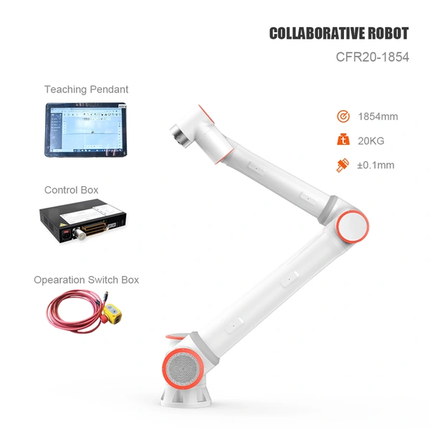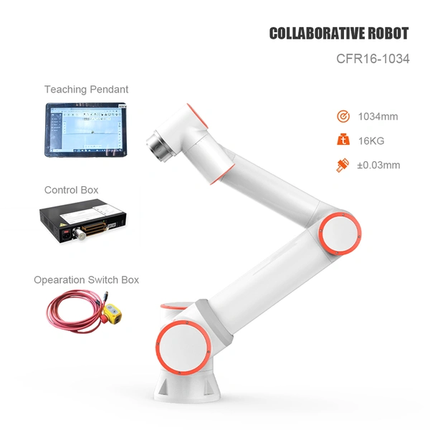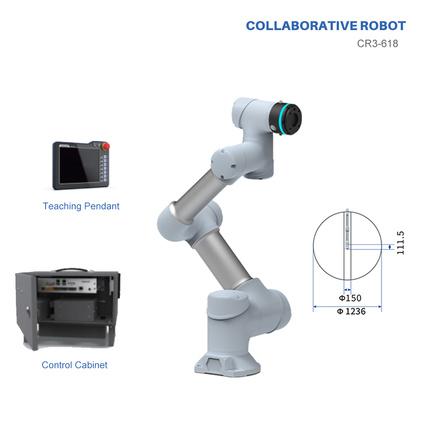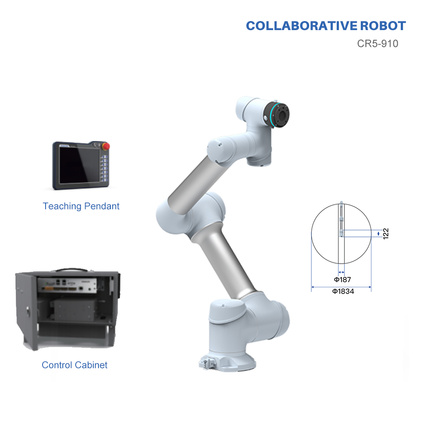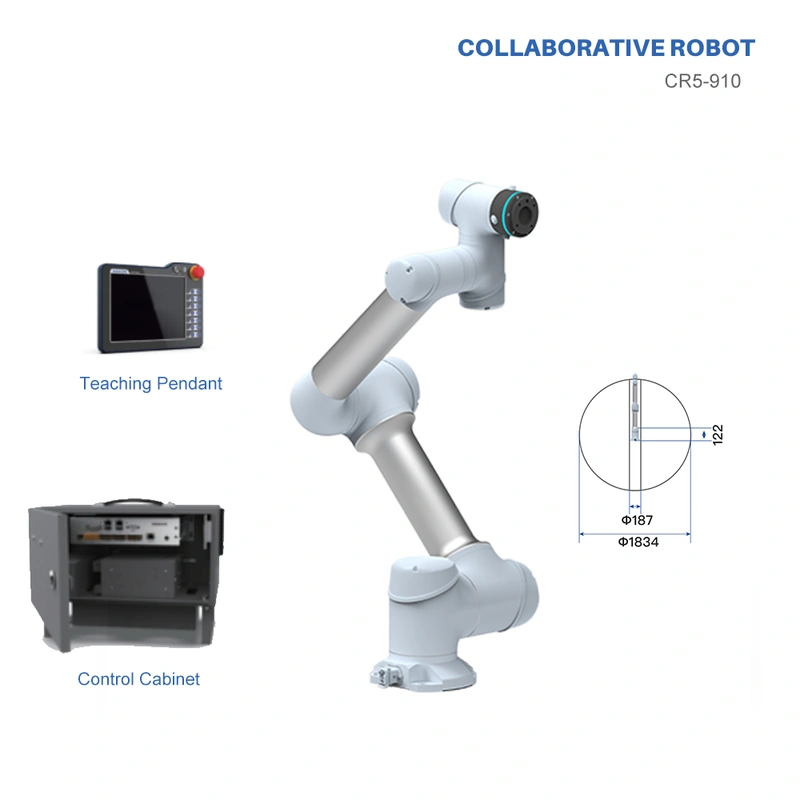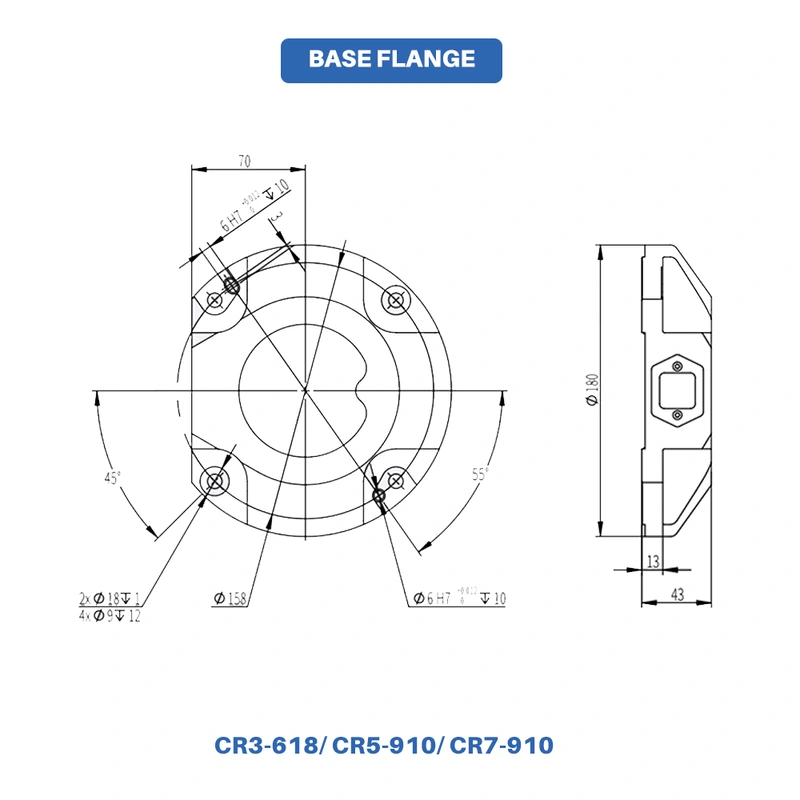


















Los robots colaborativos están diseñados específicamente para interactuar directamente y a corta distancia con los humanos en un espacio de trabajo compartido. Esta es su principal diferencia con los robots industriales tradicionales: mientras que estos últimos deben estar físicamente aislados —normalmente detrás de vallas de seguridad— para garantizar la seguridad, los robots colaborativos pueden trabajar codo con codo con los trabajadores humanos sin necesidad de barreras físicas.

| Nombre | Robot colaborativo de la serie CR | ||
| Especificación | Modelo | CR5-910 | |
| Carga útil | 5 kg | ||
| Alcanzar | 917 mm | ||
| Grados de libertad | 6 articulaciones giratorias | ||
| HMI | Aplicación web para terminal móvil o panel de control de 10,4 pulgadas | ||
| Movimiento | Repetibilidad | ±0,02 mm | |
| Movimiento del eje | Rango de funcionamiento | Velocidad máxima | |
| 1 eje | ±360° | ±225°/s | |
| 2 ejes | ±360° | ±225°/s | |
| 3 ejes | ±360° | ±225°/s | |
| 4 ejes | ±360° | ±225°/s | |
| 5 ejes | ±360° | ±225°/s | |
| 6 ejes | ±360° | ±225°/s | |
| Velocidad máxima de TCP | 3,6 m/s | ||
| Velocidad máxima en línea recta | 1,5 m/s | ||
| Características | Clasificación IP | IP54/IP65 | |
| Interfaz de la herramienta | GB/T 14468.1-50-4-M6 (equivalente a ISO 9409-1) | ||
| Fuente de alimentación | 220-240 V CA 47-63 Hz 10 A / 100-200 V CA 47-63 Hz 16 A | ||
| Puertos de E/S | 2 entradas/salidas digitales, 24 V, 0,6 A | ||
| Rango de temperatura de almacenamiento | -40℃-55℃ | ||
| Dimensiones del robot | 1100x330x220 mm | ||
| Peso de la máquina | 22 kg | ||
| Consumo de energía | Consumo de energía típico: 200 W | ||
| Instalación | De montaje en suelo, invertido, en voladizo. Instalado en cualquier dirección. | ||
| Armario de control | Entrada de alimentación | 200-240 VCA, 47-63 Hz, 10 A 100-200 VCA, 47-63 Hz, 16 A | |
| Potencia de salida nominal | 48V a 600W | ||
| Peso | 13,6 kg | ||
| Rango de temperatura de funcionamiento | -10-50℃ | ||
| Rango de temperatura de almacenamiento | -40-55℃ | ||
| Humedad de trabajo | 20%-70% HR | ||
| Humedad de almacenamiento | 10%-95% (sin condensación) | ||
| Presión atmosférica | 70-106 kPa | ||
| Clasificación IP | IP44 | ||
| Ruido | ≤55 dB | ||
| Interfaz de comunicación | CAN, RS485, LAN, EtherCAT, INC Señal del codificador lA+, A-; B+, B-; Z+, Z- | ||
| Interfaz de usuario | 16 canales DI (tipo PNP, L: -3V~5V, H: 11V-30VDC, 2~15mA), 16 canales DO (tipo PNP, 22~28V, Máx.: 0,5A) | ||
| Caja de control | Tamaño de pantalla | 10,4 pulgadas | |
| Resolución de pantalla | 800*600/60Hz | ||
| Tipo de pantalla táctil | Capacitivo | ||
| Rango de temperatura de funcionamiento | 0℃~50℃ | ||
| Rango de humedad de funcionamiento | 10~90% HR (sin condensación) | ||
| Clasificación de protección | IP54 | ||
| Dimensiones | 295*225*45 (sin incluir la empuñadura) | ||
| Peso | 1,3 kg | ||

a. Limitación de potencia y fuerza: Los sensores de par incorporados monitorizan el par en cada articulación en tiempo real, lo que permite configurar umbrales de fuerza de colisión por debajo de los límites de tolerancia biomecánica del cuerpo humano.
b. Parada supervisada con clasificación de seguridad: Incorpora capacidades de enclavamiento de E/S de seguridad integradas.
c. Monitorización de velocidad y separación: Permite el ajuste en tiempo real de la velocidad de movimiento mediante un PLC de seguridad.
d. Repetibilidad: ±0,02 mm
e. Collaborative robots are ideally suited for flexible manufacturing environments characterized by high-mix, variable-batch production—such as laser marking of medical devices, precision assembly, and optical inspection. While maintaining industrial-grade repeatability, they provide a collaborative workspace between humans and machines that is unattainable with traditional robotic systems.
The application value of collaborative robots stems from their three key technical features: force control perception, visual guidance, and flexible deployment. Below, we analyze four core application directions from the perspective of technical implementation.
1. Precise Assembly and Force Control Insertion
In traditional rigid assembly, positional deviations can lead to jamming or damage to the workpiece. Collaborative robots adopt a torque control mode, allowing the end to promptly sense contact force and actively adapt. A typical application is the insertion of electronic connectors: The robot initially applies a force of 0.5N to search for the hole position. Upon detecting a sudden change in force, it automatically adjusts its posture to achieve a precise insertion with a gap of 0.1mm, resulting in a yield rate of up to 99.9%.
II. Adaptive Grinding and Polishing
The workpiece blank has a ±1mm dimensional tolerance. Traditional position control robots are difficult to adapt to this. Collaborative robots use a force/position hybrid control method to maintain a constant contact force between the end tool and the workpiece surface (with an accuracy of ±0.5N), automatically compensating for trajectory deviations. It is suitable for surface treatment of automotive parts, bathroom hardware, and other products.
III. Machine Vision Guided Grasping
The collaborative robot equipped with 2D/3D cameras achieves visual servoing through hand-eye calibration. A typical application is the sorting of scattered and stacked workpieces: the deep learning model identifies the position and orientation of the workpieces, and the robot plans the grasping trajectory in real time. No precise positioning of the tray is required. During production changeovers, only the visual model needs to be switched, and the programming time is compressed from several hours to minutes.
IV. Mobile Collaborative Composite Robot
The collaborative arm is mounted on the AMR chassis to form an integrated "hand-eye-foot" system. It is suitable for cross-workstation material handling and operation scenarios, such as in a machining production line: The AMR moves to the lathe, the mechanical arm grabs the blank and feeds it into the spindle, and after completion, the finished product is taken out and sent to the inspection station. Communication is achieved through 5G + OPC UA, with millisecond-level collaboration.
Las cuatro direcciones anteriores representan el camino a través del cual los robots colaborativos evolucionan desde "acciones repetitivas en estaciones de trabajo fijas" hasta "adaptabilidad ambiental y tareas diversificadas".