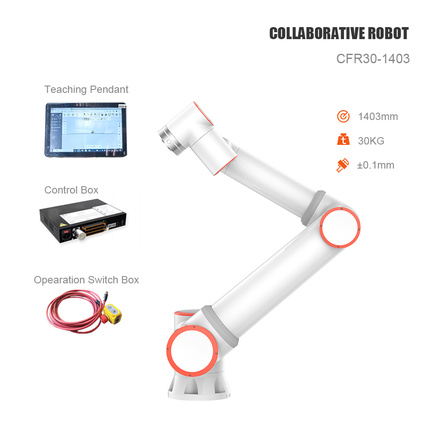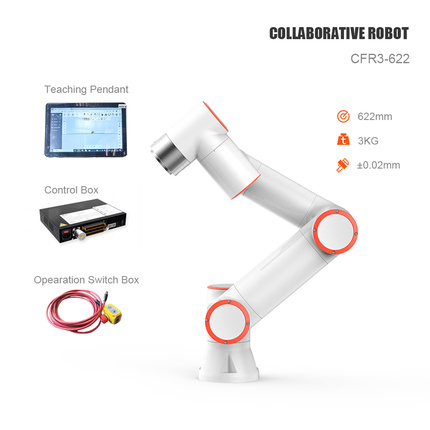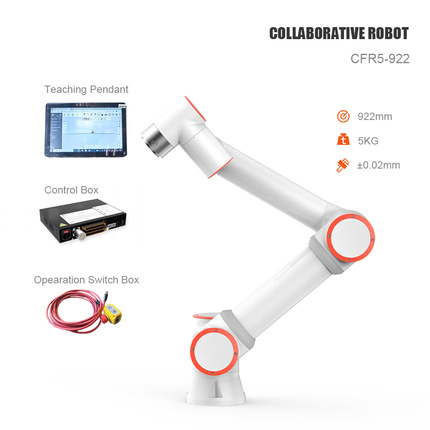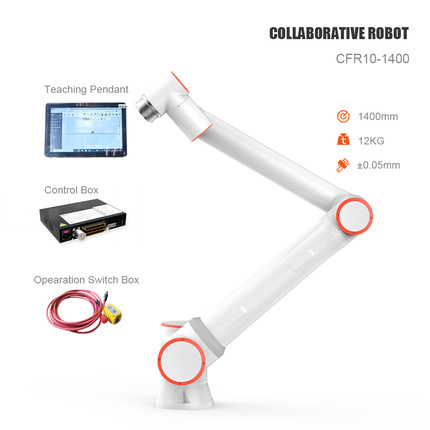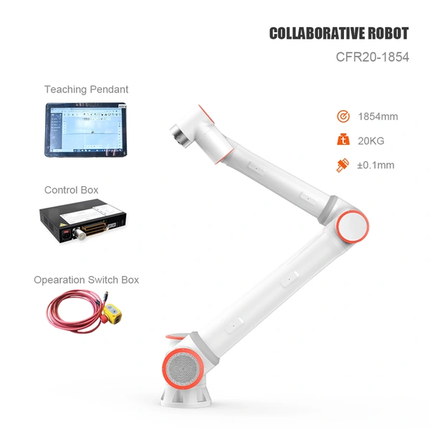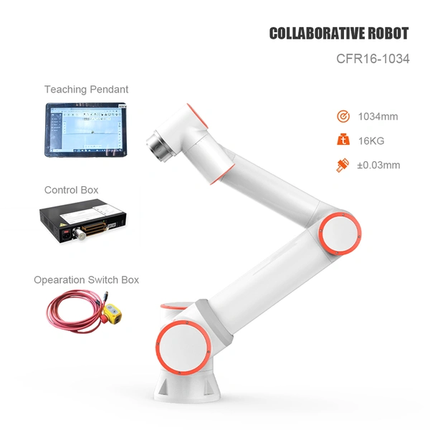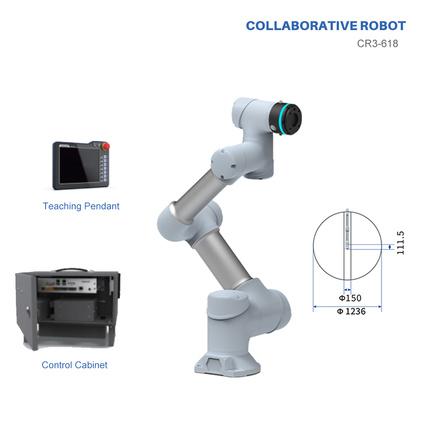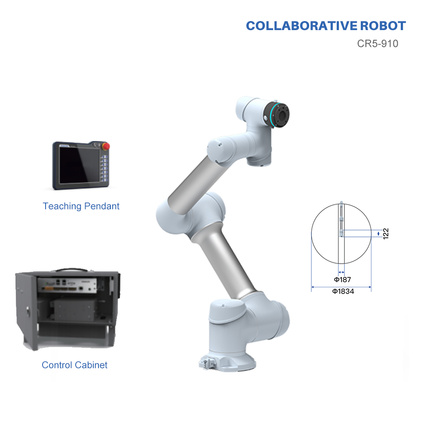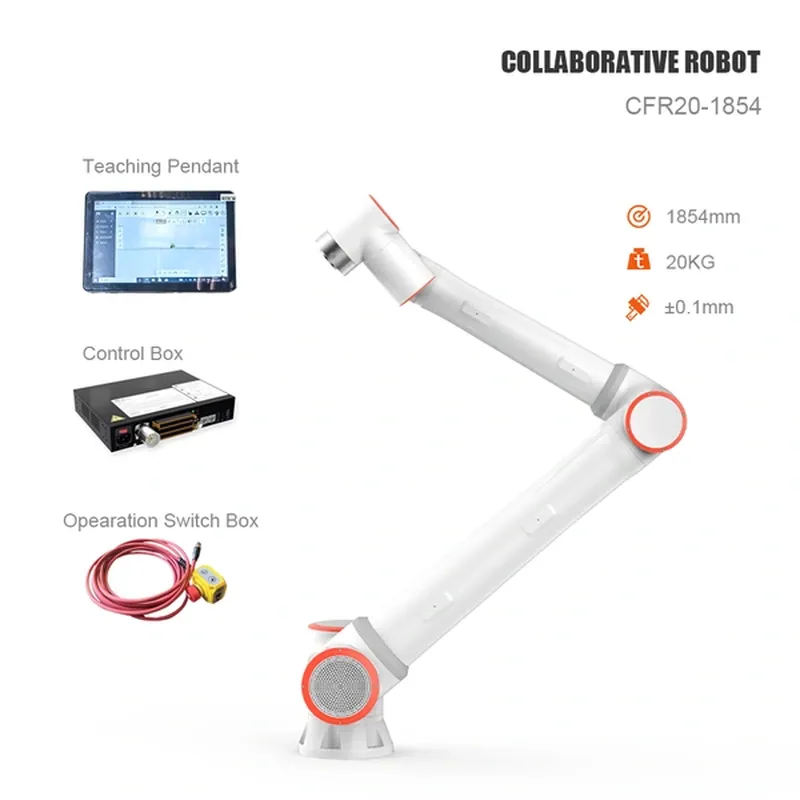















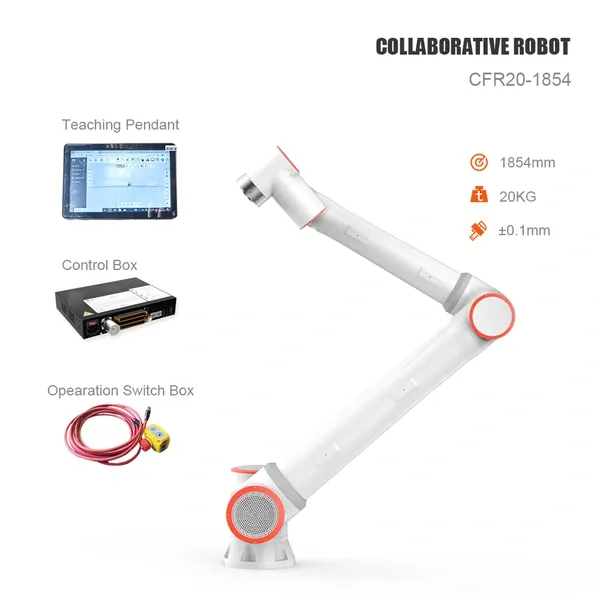


Коллаборативный робот — это интеллектуальное роботизированное устройство, специально разработанное для безопасного взаимодействия с людьми в одном рабочем пространстве. В отличие от традиционных промышленных роботов, требующих физической изоляции с помощью защитных барьеров, коллаборативные роботы, оснащенные встроенными датчиками силы, системой обнаружения столкновений и имеющие легкую конструкцию, могут работать бок о бок с рабочими без необходимости физического разделения.

| Имя | Интеллектуальный робот для совместной работы | ||
| Спецификация | Модель | CFR20-1854 | |
| Полезная нагрузка | 20 кг | ||
| Достигать | 1854 мм | ||
| Степени свободы | 6 вращающихся шарниров | ||
| ЧМИ | 10,1-дюймовый пульт дистанционного управления или мобильный терминал с веб-приложением | ||
| Движение | Повторяемость | ±0,1 мм | |
| Повторяемость положения в соответствии со стандартом ISO 9283 | ±0,1 мм | ||
| Движение по оси | Рабочий диапазон | Максимальная скорость | |
| 1 ось | ±175° | ±120°/с | |
| 2 оси | ﹢85°/﹣265° | ±120°/с | |
| 3 оси | ±160° | ±120°/с | |
| 4 оси | ﹢85°/﹣265° | ±180°/с | |
| 5 осей | ±175° | ±180°/с | |
| 6 осей | ±175° | ±180°/с | |
| Типичная скорость TCP | 2 м/с | ||
| Функции | классификация IP | Степень защиты IP54 (IP65 опционально) | |
| Шум | <65 дБ | ||
| установка робота | Любая ориентация | ||
| Порты ввода/вывода | Цифровой вход (DI) 2, цифровой выход (DO) 2, аналоговый вход (AI) 2, аналоговый выход (AO) 2, высокоскоростной импульсный вход 2. | ||
| Источник питания ввода/вывода инструмента | 24 В/1,5 А | ||
| Физический | След | 240 мм | |
| Масса | 85 кг (вес без проволоки) | ||
| Рабочая температура | 0-45℃ | ||
| Рабочая влажность | 90% относительной влажности (без конденсации) | ||
| Материалы | Алюминий, сталь | ||
| Средняя мощность | 620 Вт | ||
| Блок управления | Стандартная связь | Ввод/вывод, TCP/IP, Modbus_TCP/RTU | |
| Дополнительная связь | CC-Link, Profinet, Ethernet/lP, EtherCAT | ||
| комплект для разработки программного обеспечения | C#/C++/Python/ROS/ROS2 | ||
| Л*В*Х | 245*180*89 мм | ||
| Масса | 2,957 кг | ||
| Материалы | Оцинкованная пластина | ||
| Источник питания | 30-60 В постоянного тока | ||
| Машинный язык | Поддерживается индивидуальная настройка на английском, китайском, русском, корейском, японском, французском и других языках. | ||

Шестиосевой коллаборативный робот специально разработан для работы с мелкими деталями, сборки, захвата и перемещения и т.д. Благодаря встроенным датчикам крутящего момента и безопасности этот коллаборативный робот обеспечивает безопасность при работе с операторами.
Он имеет грузоподъемность 3 килограмма и разработан с учетом малого веса, что делает его идеальным для сборки электроники, сортировки мелких деталей, работы с легкими станками и контроля качества, а также для других задач.
Почему стоит выбрать именно этого робота-помощника?
1. Безопасное взаимодействие человека и машиныВстроенные датчики безопасности способны обнаруживать ситуации контакта и немедленно останавливать роботизированную руку.
Нет необходимости в защитных перегородках — экономит производственные площади и затраты на монтаж.
Соответствует стандартам безопасности ISO 10218.
2. Чрезвычайно прост в использовании.Программирование обучения методом перетаскивания: удерживайте манипулятор и направляйте его для выполнения действия.
Знания в программировании не требуются — сотрудник сможет освоить работу с программой менее чем за час.
Для обработки более сложных последовательностей предусмотрен графический интерфейс.
3. Легкий и портативныйВесит всего [15 килограммов] — один человек может его нести и повторно использовать.
Не требуется специальный фундамент или тяжелые монтажные приспособления.
Возможность перемещения рабочих мест между различными рабочими зонами в зависимости от изменений производственной потребности.
4. Требования к точности мелких деталей.Погрешность повторения ±0,02 миллиметра обеспечивает точное размещение мельчайших компонентов.
Шестиосевая свобода позволяет работать под любым углом, что идеально подходит для использования в узких пространствах.
5. Быстрая окупаемость инвестицийReplace repetitive manual work with automation technology
7X24 hours operation capability
Typical investment payback period: 6 to 12 months

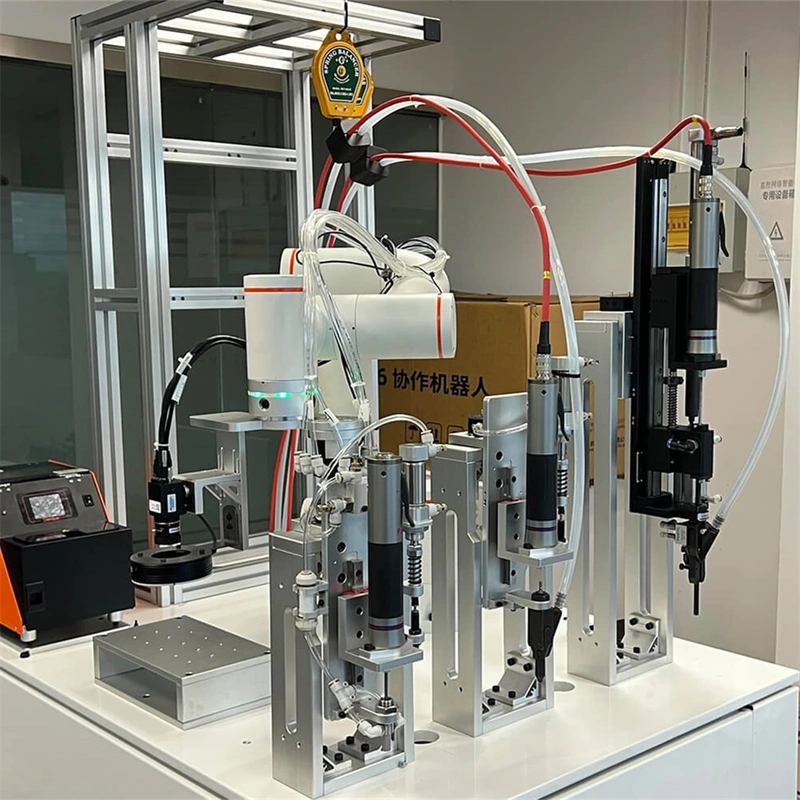
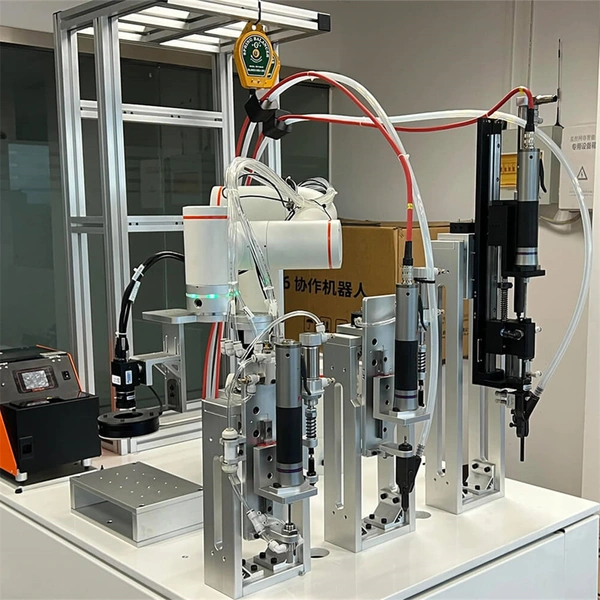
Collaborative robots are widely used in precise assembly and screw fastening, especially in the 3C electronics and automotive parts industries. With a high-precision force control system, collaborative robots can achieve accurate torque control during screw fastening and flexible wiring cable insertion, avoiding product damage caused by improper force. In automotive parts assembly, flexible mechanical arms can flexibly adapt to the assembly requirements of different model components, effectively improving production efficiency and assembly quality.
2. WeldingCollaborative robots are rapidly penetrating industries with high demands for flexible welding, such as steel structures and ships. Through dragging teaching and graphical programming, collaborative robots can quickly switch welding parameters and process paths, solving the problems of complex debugging and high costs in traditional welding equipment in small batch production. UJIAN Technology's "Steel Tailor" intelligent welding robot can autonomously identify weld seams, plan paths, and adjust parameters in real time.
3. PalletizingThe growth of the palletizing application market is mainly driven by the two major industries of food and beverage and chemical products. The post-packaging process of small and medium-sized food and beverage and daily chemical enterprises mostly still uses manual handling, resulting in low efficiency and rising labor costs. Collaborative palletizing robots have better solved these problems, achieving automated flexible palletizing, and the market is growing rapidly.
4. Material Handling and Loading and UnloadingCollaborative robots can cooperate with CNC machines, injection molding machines, etc., to achieve automated loading and unloading, reducing the labor intensity of manual work. In the electronics production line, collaborative robots can save waiting time at workstations by using dual gripper positions and improve production efficiency. For example, after a collaborative robot grabs a component from secondary injection molding, it is sent to the cutting board and automatically cycles, requiring only one operator per shift, and the production capacity can be increased by three times.
5. Inspection and Quality MonitoringCombined with machine vision technology, collaborative robots can perform product appearance inspection, size measurement, etc., improving the quality control level. In PCB circuit board inspection, collaborative robots are equipped with structured light systems to accurately detect micro cracks, bent pins, etc., and record each inspection data to achieve quality traceability.
6. Grinding and PolishingCollaborative robots, with their flexible deployment and human-machine collaboration characteristics, are gradually overcoming the pain points of low efficiency and large dust hazards in traditional grinding operations. In fine grinding of 3C product appearance parts and surface treatment of automotive parts in specific scenarios, their application potential is huge.
7. PaintingWith the launch of explosion-proof collaborative robots, the application of collaborative robots has gradually expanded to painting work in high-temperature and high-risk environments, and its recognition in the painting field has increased due to its high sealing and dust-proof characteristics.
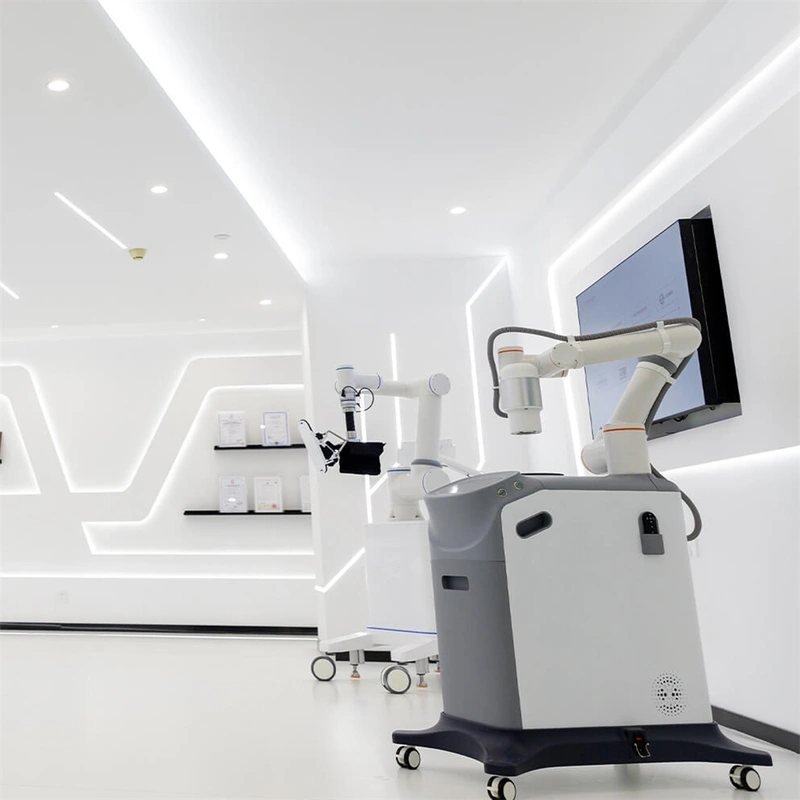
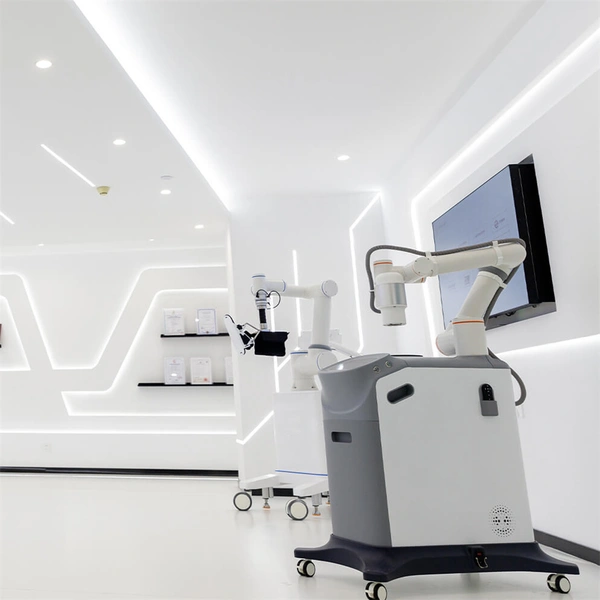
Non-Industrial Applications1. Medical and Laboratory AutomationSurgical assistance: Collaborative robots can assist doctors in performing minimally invasive surgeries, improving operation stability and accuracy.
Rehabilitation training: In rehabilitation medicine, collaborative robots can help patients perform limb movement training to promote functional recovery.
Laboratory automation: Collaborative robots can be used for sample sorting, tube transportation, and experimental operations, improving laboratory efficiency and reducing the risk of human contamination. In diagnostic laboratories, collaborative robots handle samples in clean rooms without rest, contamination, or errors.
2. Logistics and WarehousingWarehouse handling: Collaborative robots can be combined with AGVs to achieve automatic handling and stacking of goods.
Order sorting and packaging: In e-commerce logistics centers, collaborative robots can quickly identify and sort goods and complete automated packaging. For example, Vention's collaborative robots can fold 5-7 boxes per minute, accurately completing the packing.
3. Catering and RetailSmart Coffee Workstation: Equipped with a standardized robotic arm control system, it can not only perform general coffee-making procedures but also customize extraction time and milk froth ratio according to user preferences.
Food Preparation: Collaborative robots can be used for cake decoration, food packaging, etc. From cream frosting to sushi rolling, collaborative robots complete precise decoration and packaging with food-grade safety standards.
4. Business ServicesSmart Massage Workstation: Through standardized mechanical transmission and pressure feedback modules, combined with user body type data, it provides personalized massage plans.
Guidance and Customer Service: Some collaborative robots have voice interaction and navigation functions, which can be applied in shopping malls, airports, etc. to provide guidance and consultation services.
5. AgricultureCollaborative robots can be used for fruit and vegetable picking and greenhouse management to improve the automation level of agricultural production.
6. Other Emerging IndustriesEnergy: Assist in equipment inspection and maintenance in dangerous environments to ensure personnel safety.
Образование: В качестве учебного пособия он помогает студентам и исследователям изучать программирование роботов и технологии их применения.