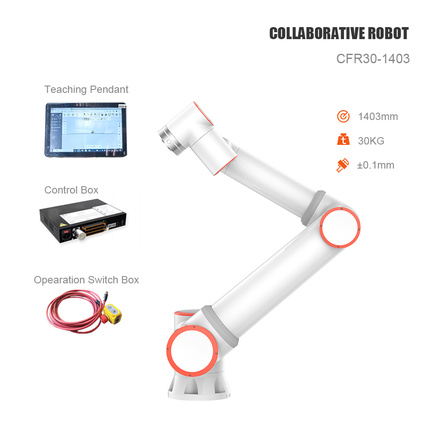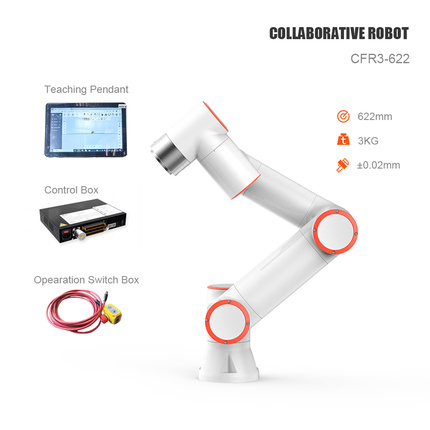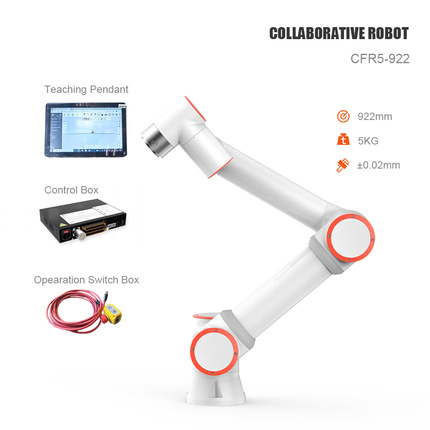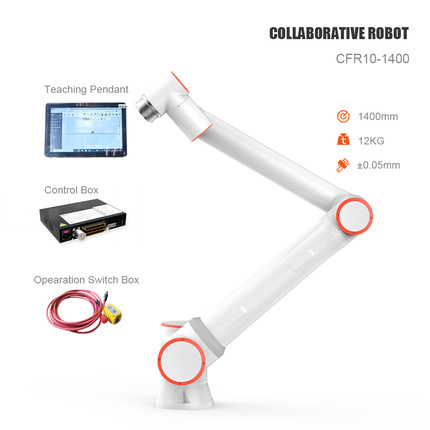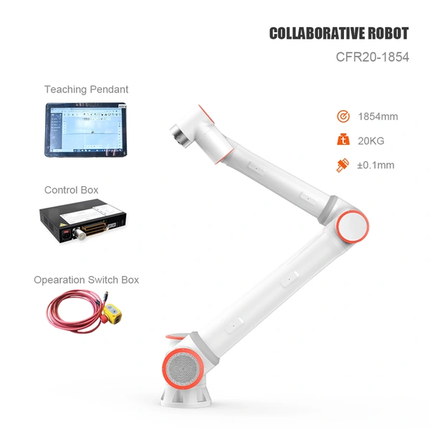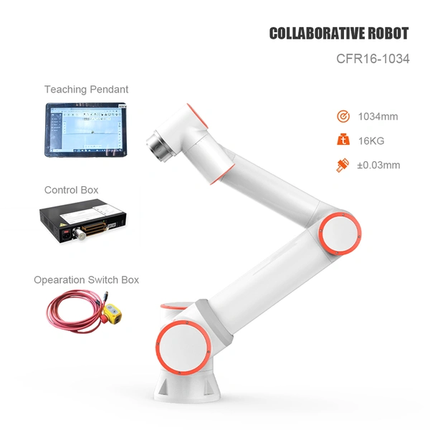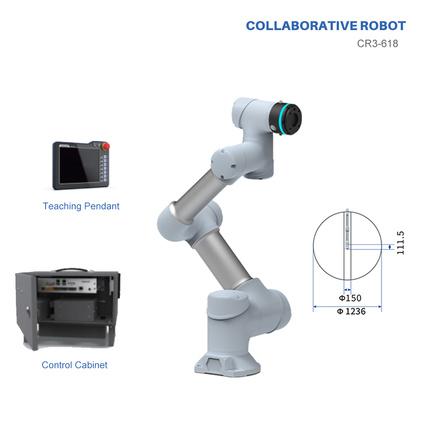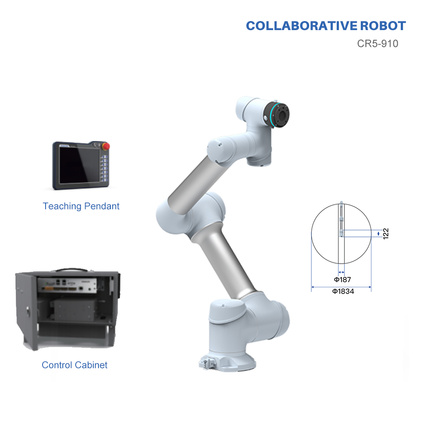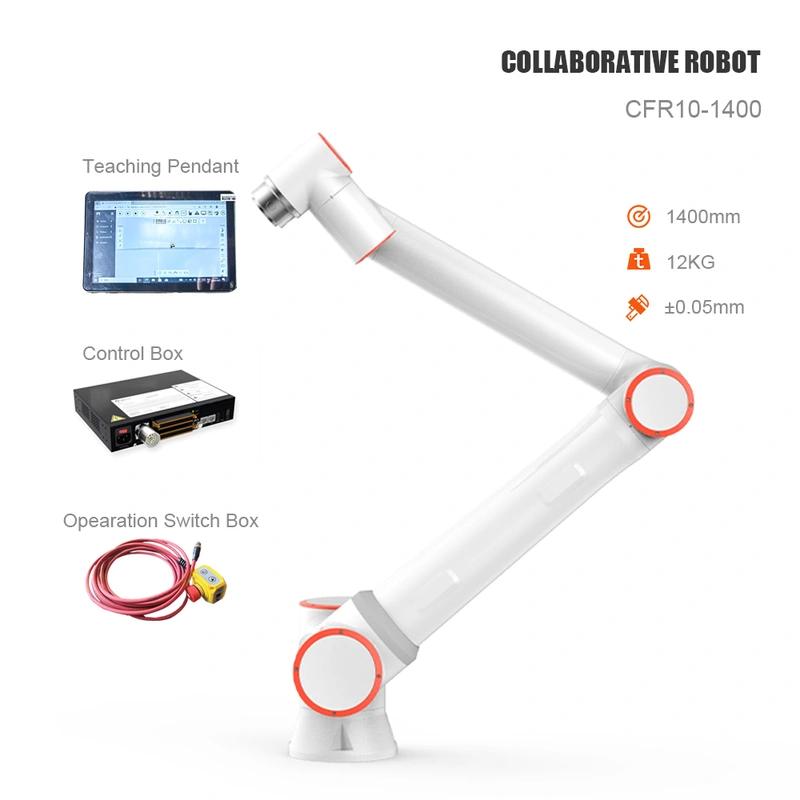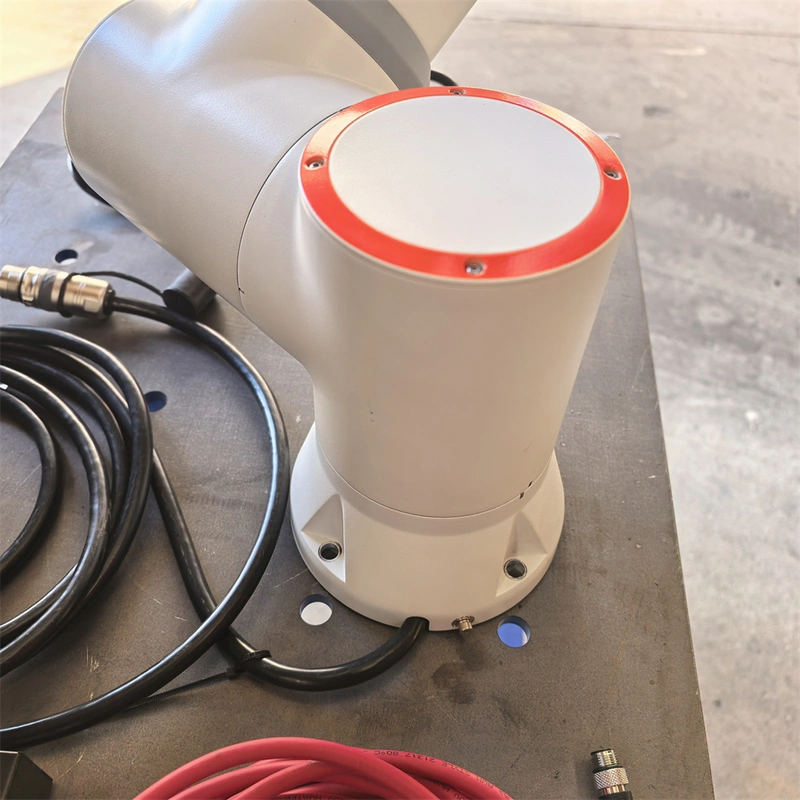















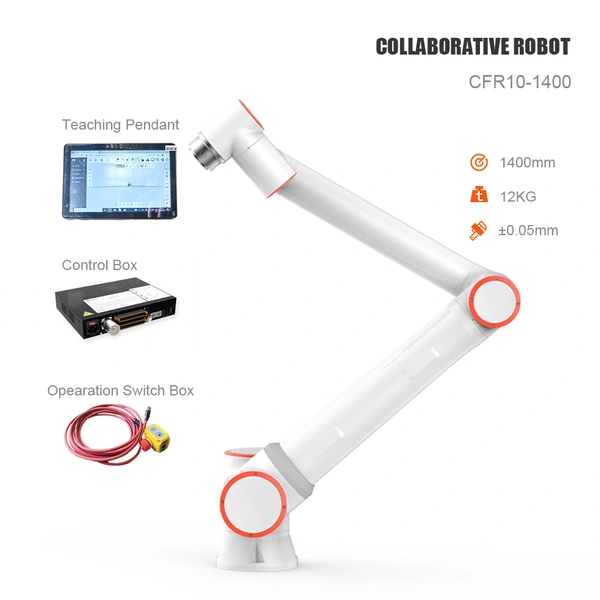


Коллаборативный робот — это интеллектуальное роботизированное устройство, специально разработанное для безопасного взаимодействия с людьми в одном рабочем пространстве. В отличие от традиционных промышленных роботов, требующих физической изоляции с помощью защитных барьеров, коллаборативные роботы, оснащенные встроенными датчиками силы, системой обнаружения столкновений и имеющие легкую конструкцию, могут работать бок о бок с рабочими без необходимости физического разделения.

| Имя | Интеллектуальный робот для совместной работы | ||
| Спецификация | Модель | CFR10-1400 | |
| Полезная нагрузка | 10 кг | ||
| Достигать | 1400 мм | ||
| Степени свободы | 6 вращающихся шарниров | ||
| ЧМИ | 10,1-дюймовый пульт дистанционного управления или мобильный терминал с веб-приложением | ||
| Движение | Повторяемость | ±0,05 мм | |
| Повторяемость положения в соответствии со стандартом ISO 9283 | ±0,05 мм | ||
| Движение по оси | Рабочий диапазон | Максимальная скорость | |
| 1 ось | ±175° | ±120°/с | |
| 2 оси | ﹢85°/﹣265° | ±120°/с | |
| 3 оси | ±160° | ±180°/с | |
| 4 оси | ﹢85°/﹣265° | ±180°/с | |
| 5 осей | ±175° | ±180°/с | |
| 6 осей | ±175° | ±180°/с | |
| Типичная скорость TCP | 1 м/с | ||
| Функции | классификация IP | Степень защиты IP54 (IP65 опционально) | |
| Шум | <65 дБ | ||
| установка робота | Любая ориентация | ||
| Порты ввода/вывода | Цифровой вход (DI) 2, цифровой выход (DO) 2, аналоговый вход (AI) 2, аналоговый выход (AO) 2, высокоскоростной импульсный вход 2. | ||
| Источник питания ввода/вывода инструмента | 24 В/1,5 А | ||
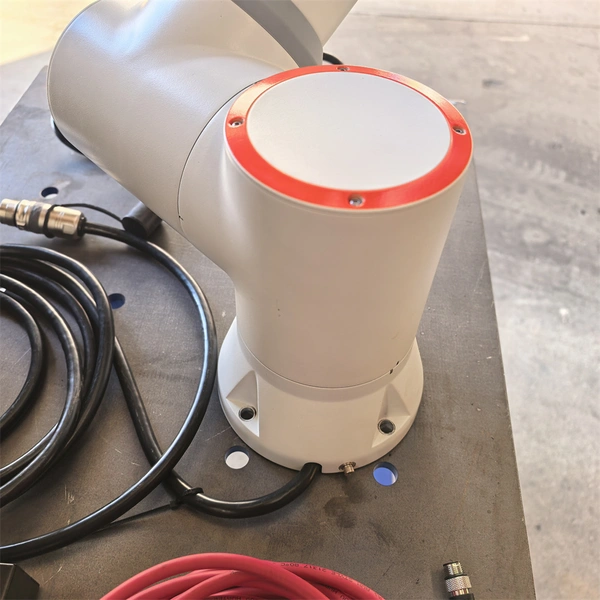
| Физический | След | 190 мм | |
| Масса | 40 кг (вес без проволоки) | ||
| Рабочая температура | 0-45℃ | ||
| Рабочая влажность | 90% относительной влажности (без конденсации) | ||
| Материалы | Алюминий, сталь | ||
| Average Power | 300W | ||
| Control Box | Standard communication | I/O、TCP/IP、Modbus_TCP/RTU | |
| Optional communication | CC-Link、 Profinet、 Ethernet/lP、 EtherCAT | ||
| Software development kit | C#/C++/Python/ROS/ROS2 | ||
| L*W*H | 245*180*44.5mm | ||
| Weight | 2.1kg | ||
| Materials | Galvanized plate | ||
| Power supply | 30-60VDC | ||
| Machine Language | English, Chinese, Russian, Korean, Japanese, French, etc. Customization supported. | ||

The six-axis collaborative robot is specifically designed for small part handling, assembly, picking and placing, etc. This collaborative robot can maintain safety while working with operators thanks to its built-in torque and safety sensors.
It has a load capacity of 3 kilograms and is designed to be lightweight, making it ideal for electronic assembly, small part sorting, light machine operation, and quality inspection, among other tasks.
Why choose this collaborative robot?
1. Safe human-machine collaborationBuilt-in safety sensors can detect contact situations and immediately stop the robotic arm.
No need for safety barriers - saves factory floor space and installation costs
Complies with ISO 10218 safety standards
2. Extremely easy to useDrag-and-drop teaching programming: hold the arm and guide it to complete the action
No programming background required - an employee can learn to operate it in less than an hour.
A graphical interface is provided to handle more complex sequences.
3. Lightweight and portableWeighs only [15 kilograms] - one person can carry and re-deploy it
No special foundation or heavy installation fixtures required
Can move work positions between various work areas according to production demand changes
4. Precision requirements for small parts±0.02 millimeters of repeatability error ensures precise placement of tiny components.
The six-axis freedom allows for any-angle operation - perfect for use in narrow spaces
5. Quick return on investmentReplace repetitive manual work with automation technology
7X24 hours operation capability
Typical investment payback period: 6 to 12 months

Collaborative robots are widely used in precise assembly and screw fastening, especially in the 3C electronics and automotive parts industries. With a high-precision force control system, collaborative robots can achieve accurate torque control during screw fastening and flexible wiring cable insertion, avoiding product damage caused by improper force. In automotive parts assembly, flexible mechanical arms can flexibly adapt to the assembly requirements of different model components, effectively improving production efficiency and assembly quality.
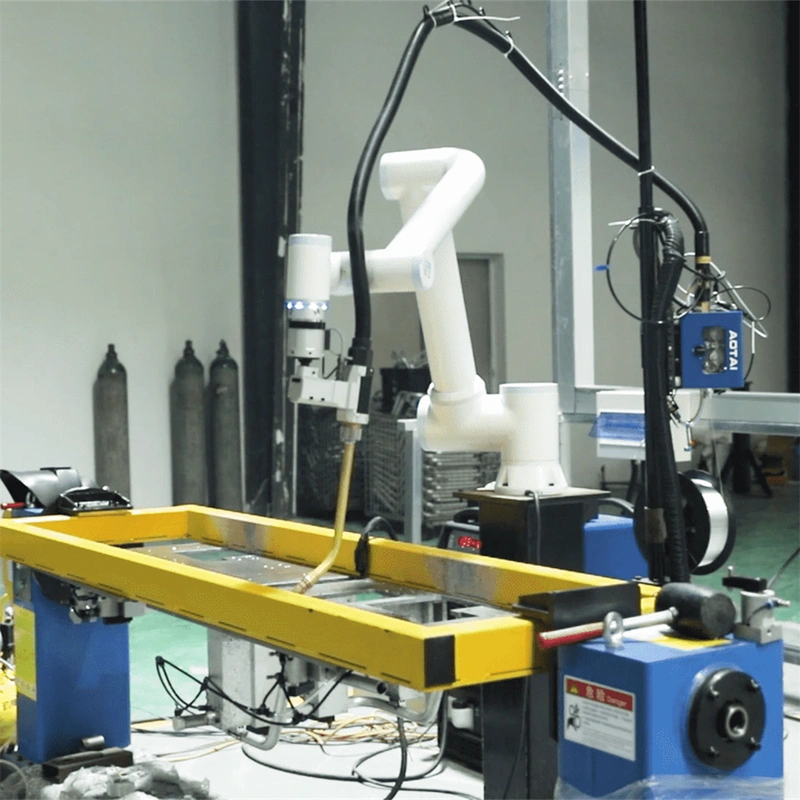
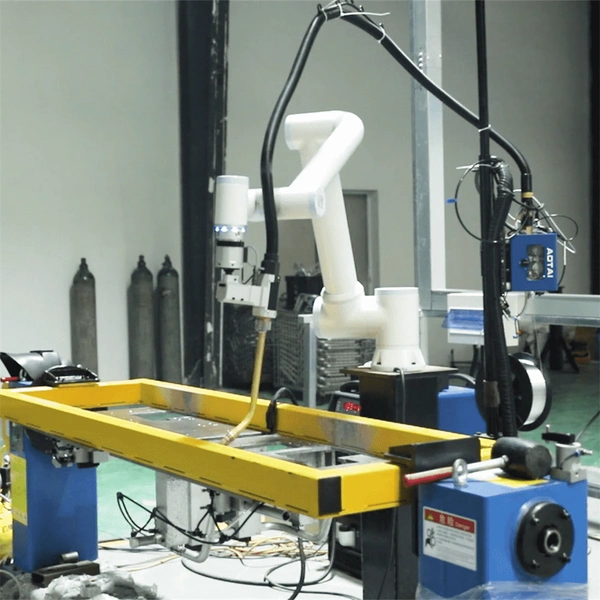
2. WeldingCollaborative robots are rapidly penetrating industries with high demands for flexible welding, such as steel structures and ships. Through dragging teaching and graphical programming, collaborative robots can quickly switch welding parameters and process paths, solving the problems of complex debugging and high costs in traditional welding equipment in small batch production. UJIAN Technology's "Steel Tailor" intelligent welding robot can autonomously identify weld seams, plan paths, and adjust parameters in real time.
3. PalletizingThe growth of the palletizing application market is mainly driven by the two major industries of food and beverage and chemical products. The post-packaging process of small and medium-sized food and beverage and daily chemical enterprises mostly still uses manual handling, resulting in low efficiency and rising labor costs. Collaborative palletizing robots have better solved these problems, achieving automated flexible palletizing, and the market is growing rapidly.
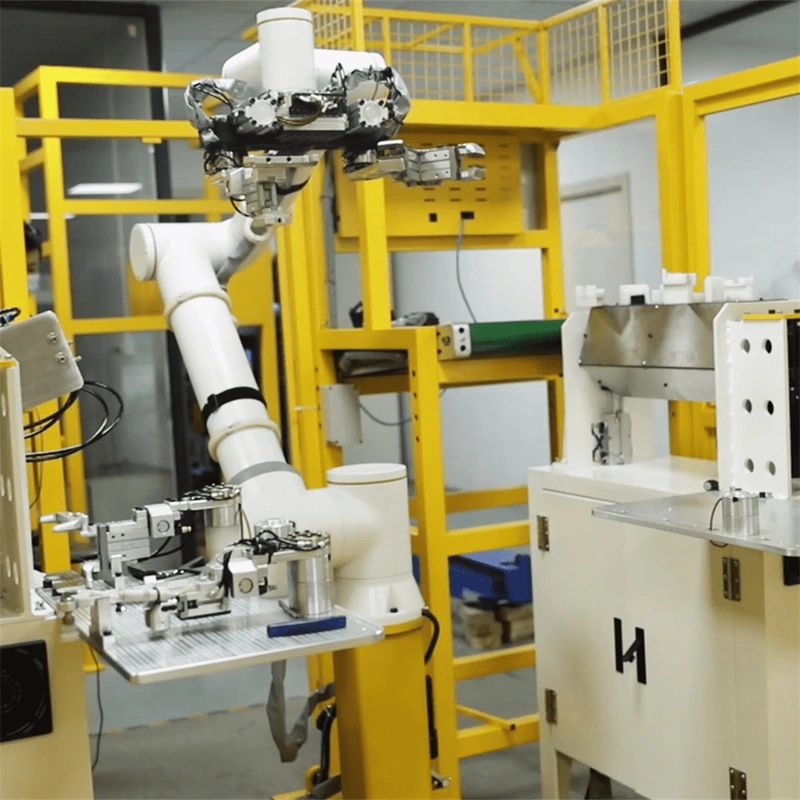
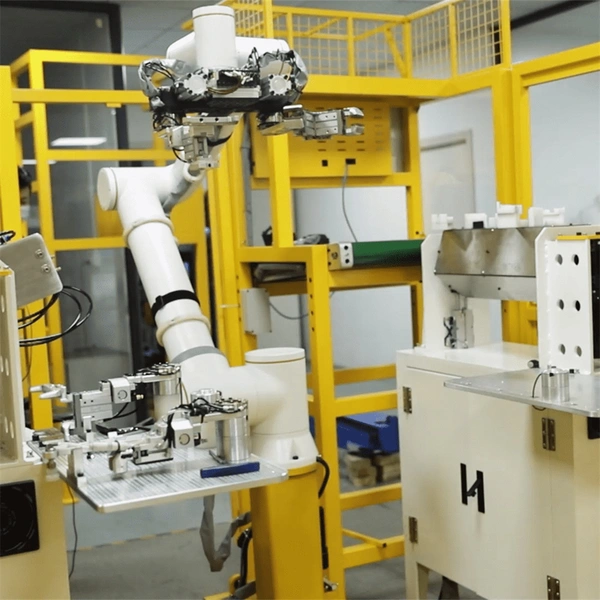
4. Material Handling and Loading and UnloadingCollaborative robots can cooperate with CNC machines, injection molding machines, etc., to achieve automated loading and unloading, reducing the labor intensity of manual work. In the electronics production line, collaborative robots can save waiting time at workstations by using dual gripper positions and improve production efficiency. For example, after a collaborative robot grabs a component from secondary injection molding, it is sent to the cutting board and automatically cycles, requiring only one operator per shift, and the production capacity can be increased by three times.
5. Inspection and Quality MonitoringCombined with machine vision technology, collaborative robots can perform product appearance inspection, size measurement, etc., improving the quality control level. In PCB circuit board inspection, collaborative robots are equipped with structured light systems to accurately detect micro cracks, bent pins, etc., and record each inspection data to achieve quality traceability.
6. Grinding and PolishingCollaborative robots, with their flexible deployment and human-machine collaboration characteristics, are gradually overcoming the pain points of low efficiency and large dust hazards in traditional grinding operations. In fine grinding of 3C product appearance parts and surface treatment of automotive parts in specific scenarios, their application potential is huge.
7. PaintingWith the launch of explosion-proof collaborative robots, the application of collaborative robots has gradually expanded to painting work in high-temperature and high-risk environments, and its recognition in the painting field has increased due to its high sealing and dust-proof characteristics.
Non-Industrial Applications1. Medical and Laboratory AutomationSurgical assistance: Collaborative robots can assist doctors in performing minimally invasive surgeries, improving operation stability and accuracy.
Реабилитационная тренировка: В реабилитационной медицине коллаборативные роботы могут помочь пациентам в выполнении тренировок движений конечностей для содействия функциональному восстановлению.
Автоматизация лабораторий: коллаборативные роботы могут использоваться для сортировки образцов, транспортировки пробирок и проведения экспериментов, повышая эффективность работы лаборатории и снижая риск заражения от рук человека. В диагностических лабораториях коллаборативные роботы обрабатывают образцы в чистых помещениях без перерывов, загрязнения или ошибок.
2. Логистика и складированиеОбработка грузов на складе: коллаборативные роботы могут быть объединены с автоматизированными транспортными средствами (AGV) для обеспечения автоматической обработки и складирования товаров.
Сортировка и упаковка заказов: В логистических центрах электронной коммерции коллаборативные роботы могут быстро идентифицировать и сортировать товары, а также выполнять автоматизированную упаковку. Например, коллаборативные роботы Vention могут складывать 5-7 коробок в минуту, точно завершая упаковку.
3. Общественное питание и розничная торговляИнтеллектуальная кофейная станция: оснащенная стандартной системой управления роботизированной рукой, она может не только выполнять основные процедуры приготовления кофе, но и настраивать время экстракции и соотношение молочной пены в соответствии с предпочтениями пользователя.
Приготовление пищи: Коллаборативные роботы могут использоваться для украшения тортов, упаковки продуктов питания и т.д. От кремовой глазури до приготовления суши, коллаборативные роботы выполняют точное украшение и упаковку в соответствии со стандартами безопасности пищевых продуктов.
4. Бизнес-услугиИнтеллектуальная массажная станция: благодаря стандартизированным модулям механической передачи и обратной связи по давлению, а также данным о типе телосложения пользователя, она предоставляет персонализированные планы массажа.
Навигация и обслуживание клиентов: Некоторые коллаборативные роботы обладают функциями голосового взаимодействия и навигации, что позволяет использовать их в торговых центрах, аэропортах и т.д. для предоставления услуг по навигации и консультированию.
5. Сельское хозяйствоКоллаборативные роботы могут использоваться для сбора фруктов и овощей, а также для управления теплицами, что позволит повысить уровень автоматизации сельскохозяйственного производства.
6. Другие развивающиеся отраслиЭнергетика: Оказание помощи в осмотре и техническом обслуживании оборудования в опасных условиях для обеспечения безопасности персонала.
Образование: В качестве учебного пособия он помогает студентам и исследователям изучать программирование роботов и технологии их применения.