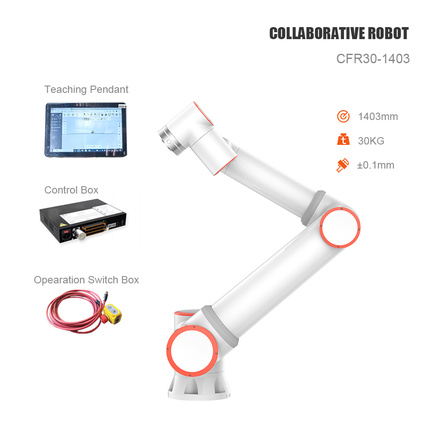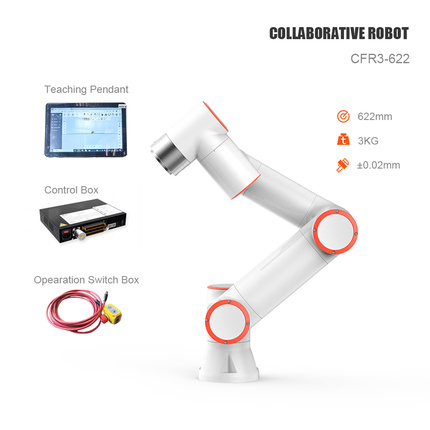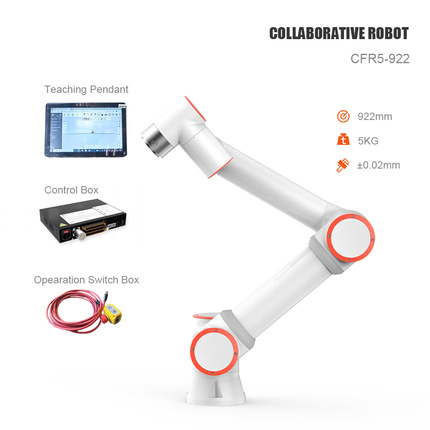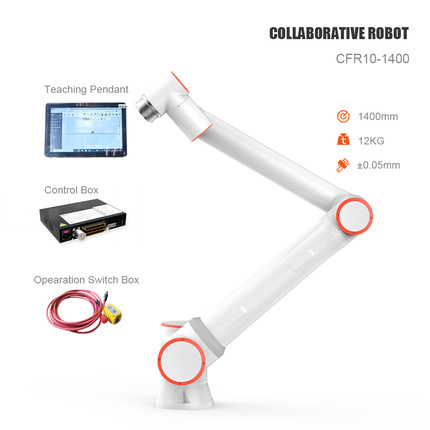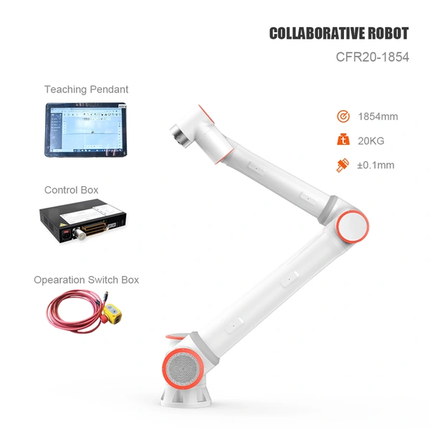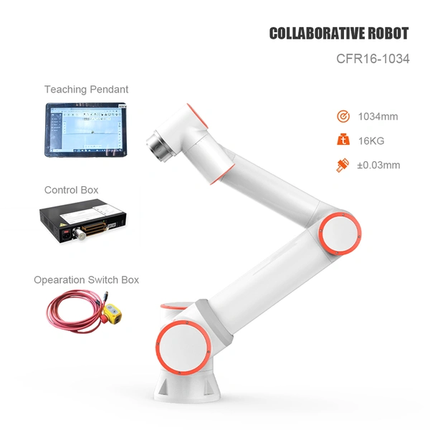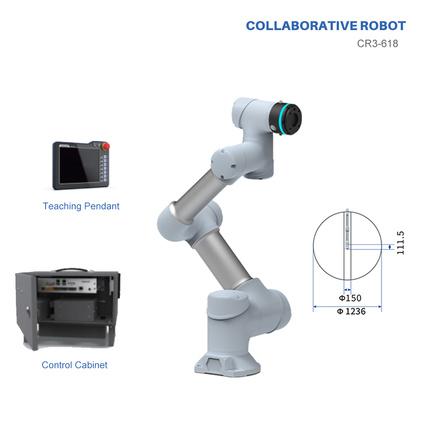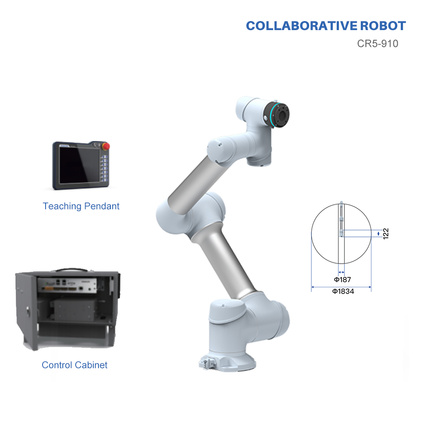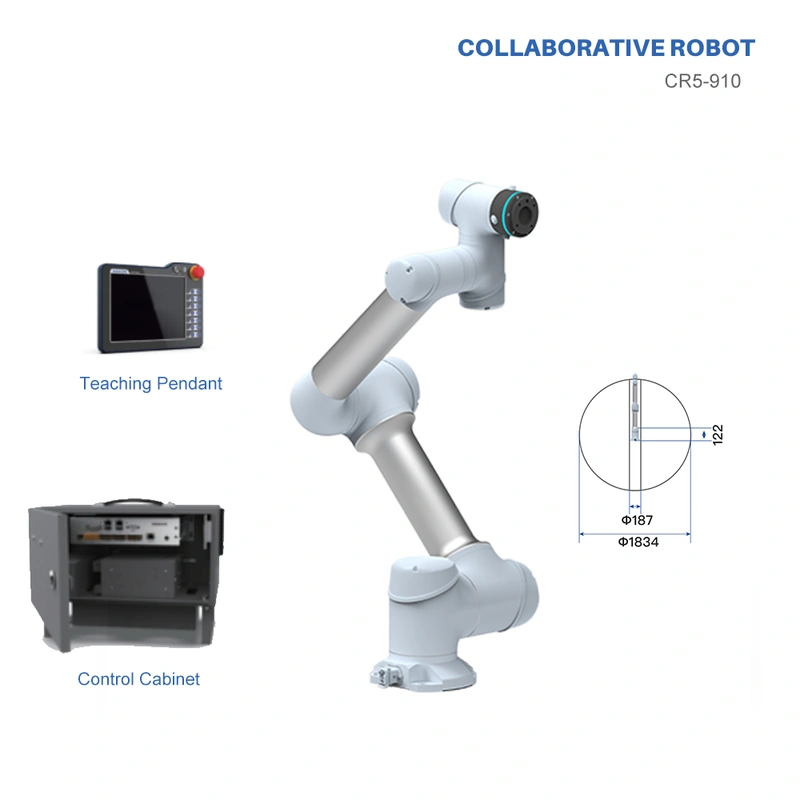















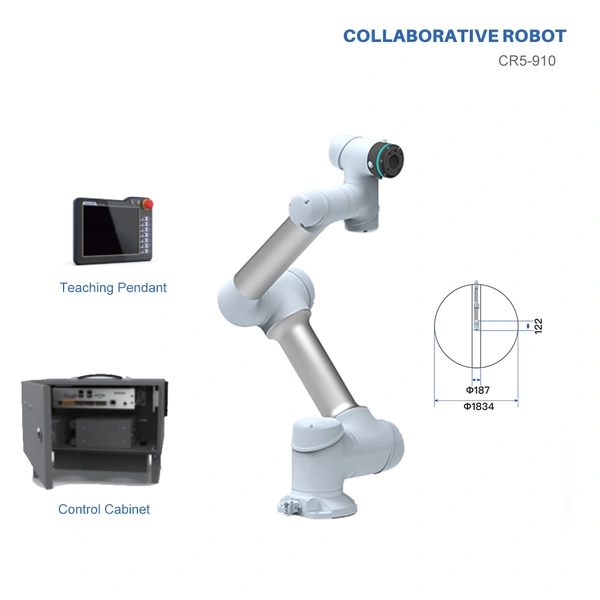



I robot collaborativi sono specificamente progettati per interagire direttamente e a stretto contatto con gli esseri umani all'interno di uno spazio di lavoro condiviso. Questa è la loro principale differenza rispetto ai robot industriali tradizionali: mentre questi ultimi devono essere fisicamente isolati, in genere dietro barriere di sicurezza, per garantire la sicurezza, i robot collaborativi possono lavorare fianco a fianco con gli operatori umani senza bisogno di barriere fisiche.

| Nome | Robot collaborativo serie CR | ||
| Specifiche | Modello | CR5-910 | |
| Carico utile | 5 kg | ||
| Portata | 917 mm | ||
| Gradi di libertà | 6 giunti rotanti | ||
| Interfaccia uomo-macchina (HMI) | Pannello di controllo da 10,4 pollici o terminale mobile con applicazione web. | ||
| Movimento | Ripetibilità | ±0,02 mm | |
| Movimento dell'asse | Campo di lavoro | Velocità massima | |
| 1 asse | ±360° | ±225°/s | |
| 2 assi | ±360° | ±225°/s | |
| 3 assi | ±360° | ±225°/s | |
| 4 assi | ±360° | ±225°/s | |
| 5 assi | ±360° | ±225°/s | |
| 6 assi | ±360° | ±225°/s | |
| Velocità massima del TCP | 3,6 m/s | ||
| Velocità massima in linea retta | 1,5 m/s | ||
| Caratteristiche | Classificazione IP | IP54/IP65 | |
| Interfaccia degli strumenti | GB/T 14468.1-50-4-M6 (equivalente a ISO 9409-1) | ||
| Alimentazione elettrica | 220-240 V CA 47-63 Hz 10 A / 100-200 V CA 47-63 Hz 16 A | ||
| Porte I/O | 2 ingressi/uscite digitali, 24 V, 0,6 A | ||
| Intervallo di temperatura di conservazione | -40℃-55℃ | ||
| Dimensioni del robot | 1100x330x220mm | ||
| Peso della macchina | 22 kg | ||
| Consumo energetico | Consumo energetico tipico: 200 W | ||
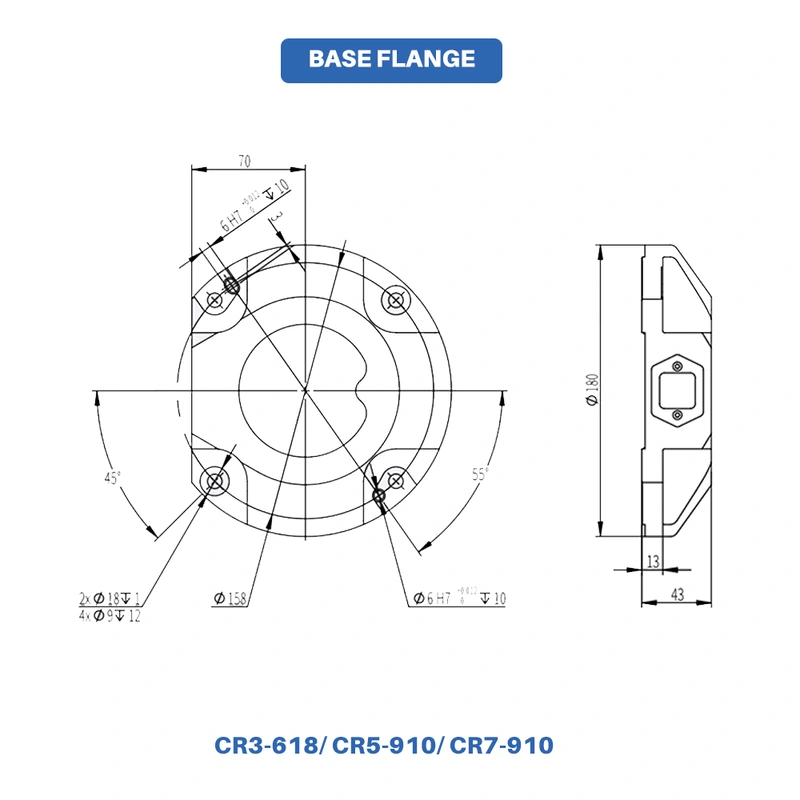
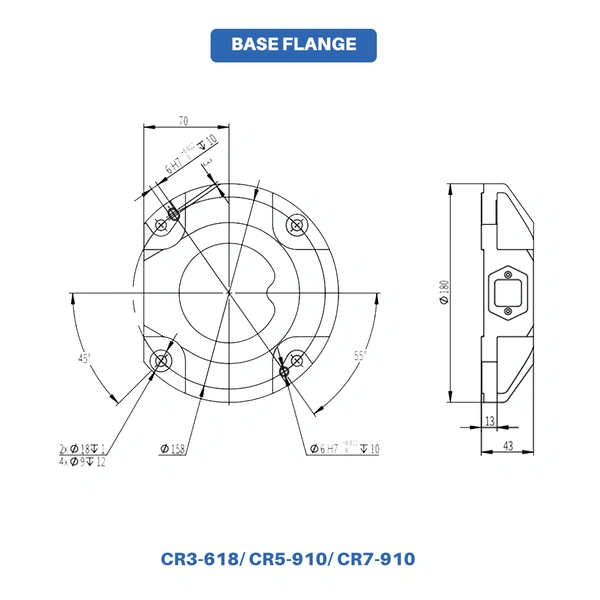
| Installazione | Montaggio a terra, invertito, a sbalzo. Installabile in qualsiasi direzione. | ||
| Armadio di controllo | Ingresso di potenza | 200-240 V CA, 47-63 Hz, 10 A 100-200 V CA, 47-63 Hz, 16 A | |
| Potenza nominale in uscita | 48V@600W | ||
| Peso | 13,6 kg | ||
| Intervallo di temperatura di funzionamento | -10-50℃ | ||
| Intervallo di temperatura di conservazione | -40-55℃ | ||
| Umidità di lavoro | 20%-70%UR | ||
| Umidità di conservazione | 10%-95% (senza condensa) | ||
| Pressione dell'aria | 70-106 kPa | ||
| Classificazione IP | IP44 | ||
| Rumore | ≤55 dB | ||
| Interfaccia di comunicazione | CAN, RS485, LAN, EtherCAT, INC Segnale encoder lA+, A-; B+, B-; Z+, Z- | ||
| Interfaccia utente | 16 canali DI (tipo PNP, L: -3V~5V, H: 11V-30VDC, 2~15mA), 16 canali DO (tipo PNP, 22~28V, Max: 0.5A) | ||
| Scatola di controllo | Dimensioni dello schermo | 10,4 pollici | |
| Risoluzione dello schermo | 800*600/60Hz | ||
| Tipo touchscreen | Capacitivo | ||
| Intervallo di temperatura di funzionamento | 0℃~50℃ | ||
| Intervallo di umidità operativa | 10-90% UR (senza condensa) | ||
| Valutazione di protezione | IP54 | ||
| Dimensioni | 295*225*45 (impugnatura esclusa) | ||
| Peso | 1,3 kg | ||

a. Limitazione di potenza e forza: i sensori di coppia integrati monitorano la coppia in tempo reale su ogni articolazione, consentendo di configurare soglie di forza d'urto inferiori ai limiti di tolleranza biomeccanica del corpo umano.
b. Arresto monitorato con certificazione di sicurezza: dotato di funzionalità integrate di interblocco I/O di sicurezza.
c. Monitoraggio della velocità e della distanza: consente la regolazione in tempo reale della velocità di movimento tramite un PLC di sicurezza.
d. Ripetibilità: ±0,02 mm
e. Collaborative robots are ideally suited for flexible manufacturing environments characterized by high-mix, variable-batch production—such as laser marking of medical devices, precision assembly, and optical inspection. While maintaining industrial-grade repeatability, they provide a collaborative workspace between humans and machines that is unattainable with traditional robotic systems.
The application value of collaborative robots stems from their three key technical features: force control perception, visual guidance, and flexible deployment. Below, we analyze four core application directions from the perspective of technical implementation.
1. Precise Assembly and Force Control Insertion
In traditional rigid assembly, positional deviations can lead to jamming or damage to the workpiece. Collaborative robots adopt a torque control mode, allowing the end to promptly sense contact force and actively adapt. A typical application is the insertion of electronic connectors: The robot initially applies a force of 0.5N to search for the hole position. Upon detecting a sudden change in force, it automatically adjusts its posture to achieve a precise insertion with a gap of 0.1mm, resulting in a yield rate of up to 99.9%.
II. Adaptive Grinding and Polishing
The workpiece blank has a ±1mm dimensional tolerance. Traditional position control robots are difficult to adapt to this. Collaborative robots use a force/position hybrid control method to maintain a constant contact force between the end tool and the workpiece surface (with an accuracy of ±0.5N), automatically compensating for trajectory deviations. It is suitable for surface treatment of automotive parts, bathroom hardware, and other products.
III. Machine Vision Guided Grasping
The collaborative robot equipped with 2D/3D cameras achieves visual servoing through hand-eye calibration. A typical application is the sorting of scattered and stacked workpieces: the deep learning model identifies the position and orientation of the workpieces, and the robot plans the grasping trajectory in real time. No precise positioning of the tray is required. During production changeovers, only the visual model needs to be switched, and the programming time is compressed from several hours to minutes.
IV. Mobile Collaborative Composite Robot
The collaborative arm is mounted on the AMR chassis to form an integrated "hand-eye-foot" system. It is suitable for cross-workstation material handling and operation scenarios, such as in a machining production line: The AMR moves to the lathe, the mechanical arm grabs the blank and feeds it into the spindle, and after completion, the finished product is taken out and sent to the inspection station. Communication is achieved through 5G + OPC UA, with millisecond-level collaboration.
Le quattro direzioni sopra descritte rappresentano il percorso evolutivo dei robot collaborativi, che passano da "azioni ripetitive in postazioni fisse" a "adattabilità ambientale e compiti diversificati".