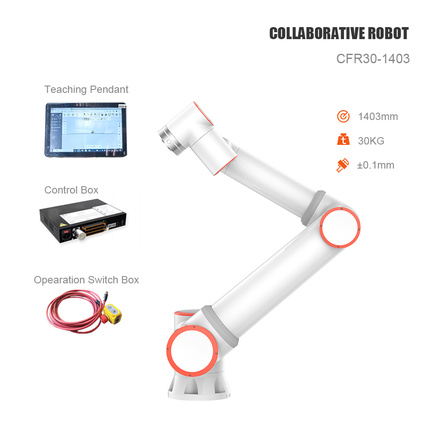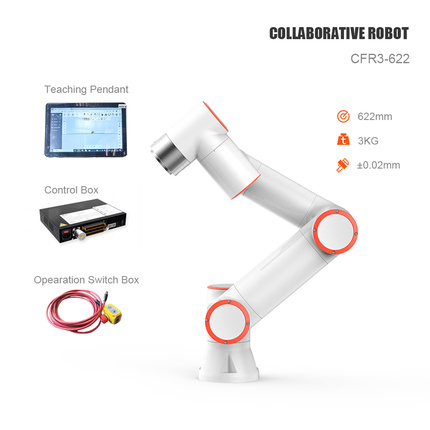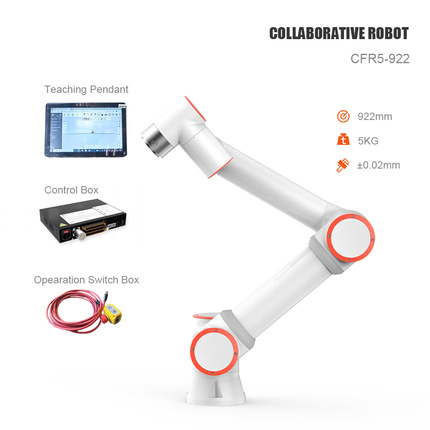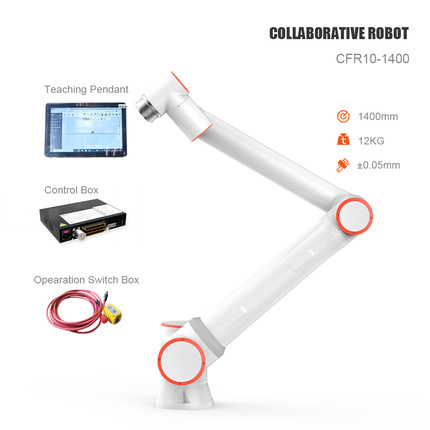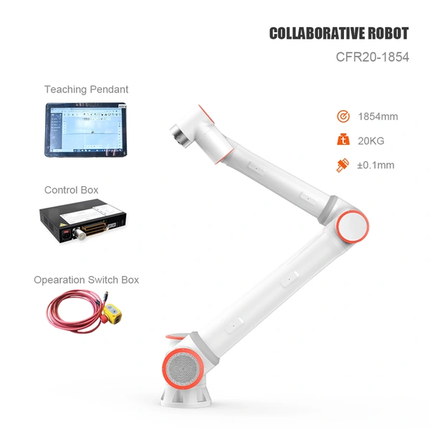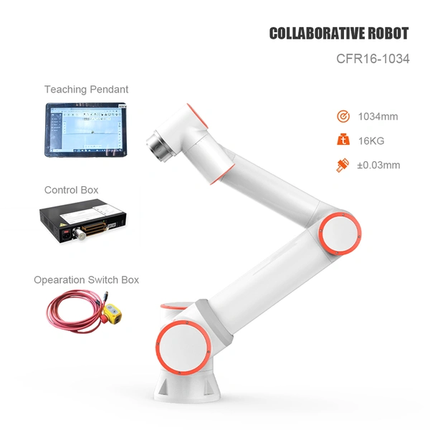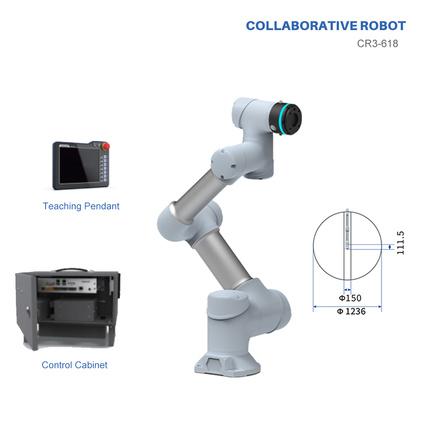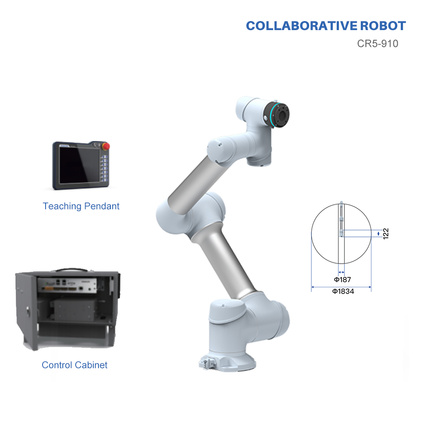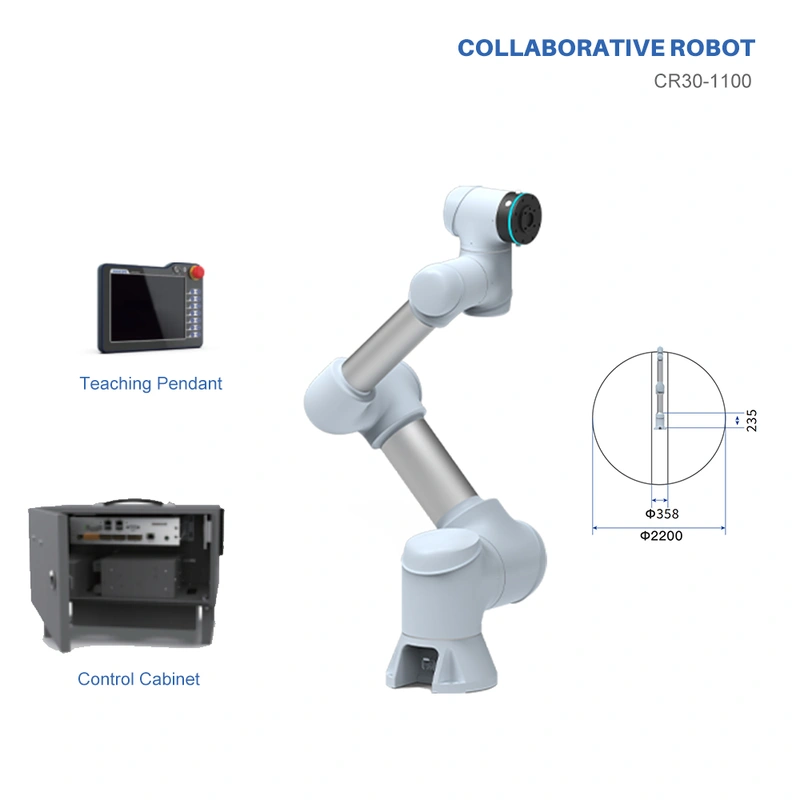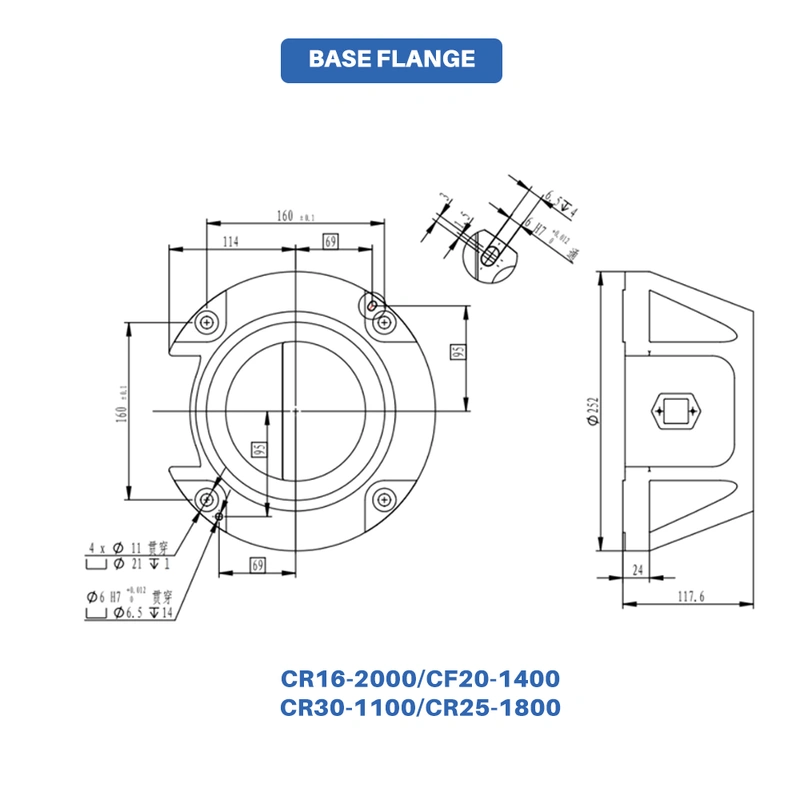















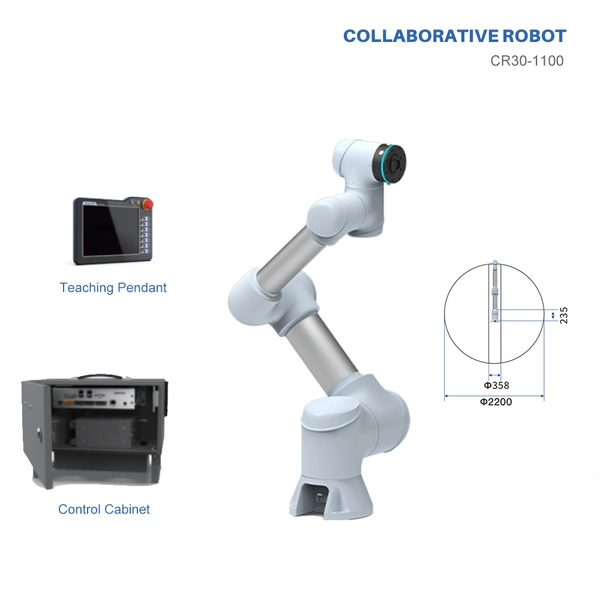
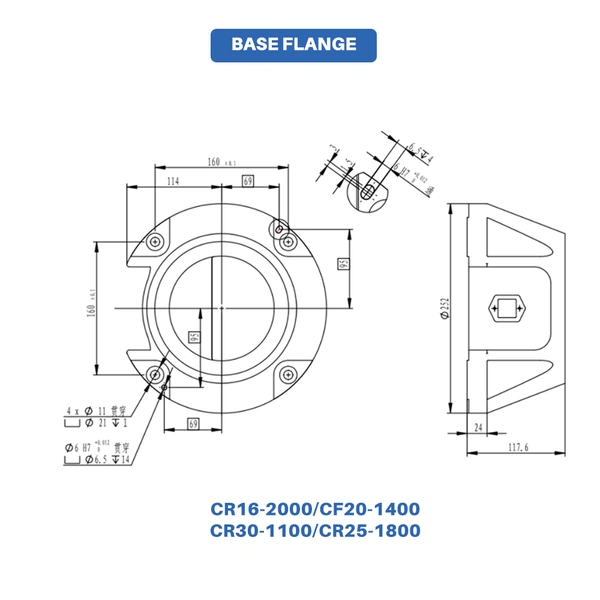



The fundamental difference between collaborative robots and traditional industrial robots lies not only in their appearance or load capacity, but in their underlying control architecture. Collaborative robots employ force/torque control loops, achieving inherent safety in scenarios where humans and robots coexist.

| Name | CR Series Collaborative Robot | ||
| Specification | Model | CR30-1100 | |
| Payload | 30kg | ||
| Reach | 1100mm | ||
| Degrees of Freedom | 6 rotating joints | ||
| HMI | 10.4 inch teach pendant or mobile terminal Web APP | ||
| Movement | Repeatability | ±0.05mm | |
| Axis Movement | Working range | Max Speed | |
| 1 axis | ±360° | ±120°/s | |
| 2 axis | ±360° | ±120°/s | |
| 3 axis | ±360° | ±180°/s | |
| 4 axis | ±360° | ±225°/s | |
| 5 axis | ±360° | ±225°/s | |
| 6 axis | ±360° | ±225°/s | |
| MAX TCP speed | 2.0m/s | ||
| Max Staight-Line Speed | 1.0m/s | ||
| Features | IP Classification | IP54/IP65 | |
| Tool Interface | GB/T 14468.1-50-4-M6(eqv ISO 9409-1) | ||
| Power Supply | 220-240VAC 47-63Hz10A/100-200VAC 47-63Hz 16A | ||
| I/O Ports | 2 Dig I/O,24V,0.6A | ||
| Storage Temperature Range | -40℃-55℃ | ||
| Robot Dimensions | 1395x420x290mm | ||
| Machine Weight | 65kg | ||
| Power Consumption | Typical Power Consumption 600W | ||
| Installation | Ground-mounted, inverted, cantilevered. Installed in any Direction | ||
| Control Cabinet | Power Input | 200-240VAC,47-63HZ,10A 100-200VAC,47-63HZ,16A | |
| Rated Output Power | 48V@600W | ||
| Weight | 13.6KG | ||
| Working Temperature Range | -10-50℃ | ||
| Storage Temperature Range | -40-55℃ | ||
| Working humidity | 20%-70%RH | ||
| Storage humidity | 10%-95% (non-condensing) | ||
| Air Pressure | 70-106kPa | ||
| IP Classification | IP44 | ||
| Noise | ≤55db | ||
| Communication Interface | CAN、RS485、LAN、EtherCAT、INC Encoder signa lA+,A-;B+,B-;Z+,Z- | ||
| User interface | 16-channel DI (PNP type, L: -3V~5V, H: 11V-30VDC, 2~15mA), 16-channel DO (PNP type, 22~28V, Max: 0.5A) | ||
| Control Box | Screen Size | 10.4 inches | |
| Screen Resolution | 800*600/60Hz | ||
| Touchscreen Type | Capacitive | ||
| Operating Temperature Range | 0℃~50℃ | ||
| Operating Humidity Range | 10~90%RH (non-condensing) | ||
| Protection Rating | IP54 | ||
| Dimensions | 295*225*45 (excluding grip) | ||
| Weight | 1.3kg | ||

a. Power and Force Limiting: Built-in torque sensors monitor the torque at each joint in real time, allowing collision force thresholds to be configured below the biomechanical tolerance limits of the human body.
b. Safety-Rated Monitored Stop: Features integrated safety I/O interlocking capabilities.
c. Speed and Separation Monitoring: Enables real-time adjustment of motion speed via a safety PLC.
d. Repeatability: ±0.02 mm
e. Collaborative robots are ideally suited for flexible manufacturing environments characterized by high-mix, variable-batch production—such as laser marking of medical devices, precision assembly, and optical inspection. While maintaining industrial-grade repeatability, they provide a collaborative workspace between humans and machines that is unattainable with traditional robotic systems.
The application value of collaborative robots is based on three major technical pillars: torque control, visual guidance, and flexible deployment. Below, we will comprehensively analyze their application directions from a technical perspective.
I. Precision Assembly and Force Control Technology
Traditional rigid assembly has extremely high requirements for positional accuracy. Even a slight deviation can lead to damage. Collaborative robots adopt a force/position hybrid control method, where the end effector can immediately sense the contact force and actively adapt to it. Typical applications include insertion of electronic connectors and bearing press-fitting. The force control accuracy can reach ±0.5N, and the gap tolerance has been relaxed from 0.01mm to 0.1mm, significantly reducing the requirements for the positioning accuracy of the front end.
II. Surface Treatment and Adaptive Grinding
The workpiece blank has a ±1mm dimensional tolerance, which is difficult for traditional position control robots to handle. The collaborative robot maintains a constant contact force between the tool and the workpiece surface through constant force control, automatically compensates for trajectory deviations, and is suitable for scenarios such as grinding of car bumpers, polishing of bathroom hardware, and sanding of wood products.
III. Machine Vision Guidance and Zero-Teaching Grasping
The collaborative robot equipped with 2D/3D cameras achieves visual servoing through hand-eye calibration. The deep learning model can identify the pose of scattered and stacked workpieces and plan the grasping trajectory in real time. During product changeover, only the visual model needs to be switched, reducing the programming time from several hours to minutes. It can also be used for quality control tasks such as product appearance inspection, size measurement, and OCR character recognition.
IV. Mobile Collaborative Composite Robot
The collaborative arm is mounted on the AMR chassis to form an integrated "hand-eye-foot" system. It is suitable for cross-workstation material handling and operation scenarios, such as in the automatic machining line: The AMR moves to the CNC machine, the mechanical arm grabs the blank and feeds it into the spindle, and after completion, the finished product is taken out and sent to the inspection station. Communication uses 5G + OPC UA to achieve millisecond-level collaboration.
V. Post-processing of Laser Processing and Additive Manufacturing
The collaborative robots work in conjunction with the laser equipment to perform cutting, welding, marking, and cleaning. In the medical device field, high-precision collaborative robots are used for laser marking of UDI codes; in the post-processing of 3D printing, they are used for support removal and surface finishing.
VI. Palletizing, Unpalletizing and Packaging
The collaborative robots are suitable for palletizing and unpalletizing tasks in various logistics warehouses and at the end of production lines. They can automatically identify different-sized cartons and stack them according to preset patterns, replacing manual heavy-lifting and reducing the risk of workplace injuries.
The technological path of collaborative robots evolving from "repetitive actions at fixed positions" to "environmental adaptability and diversified tasks" has enabled them to meet various application scenarios, bringing about great convenience.