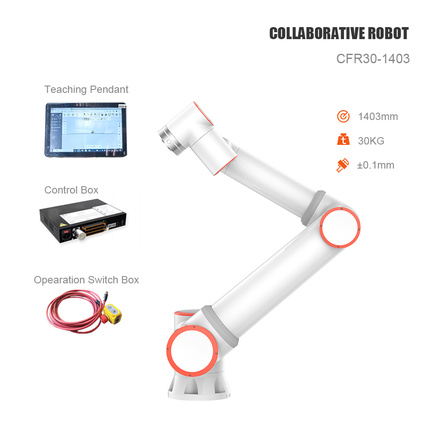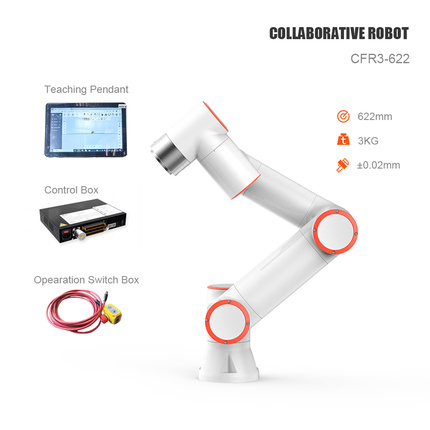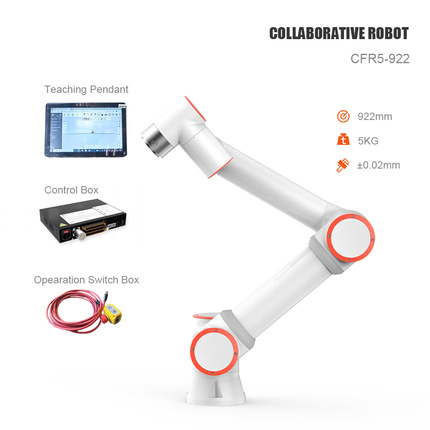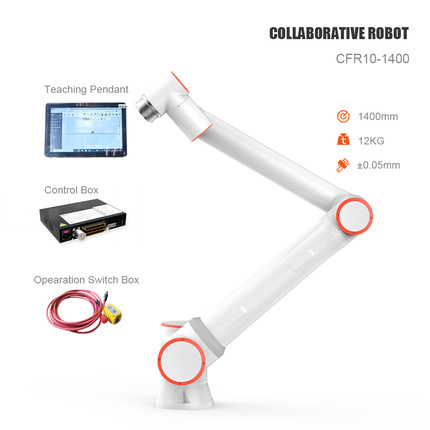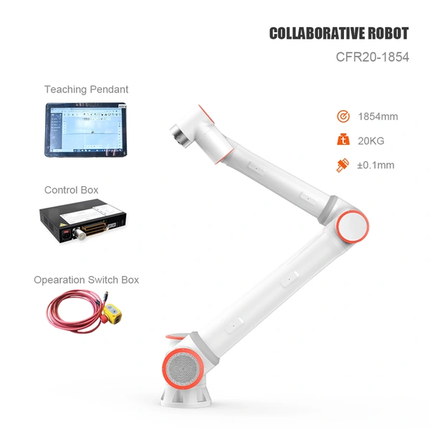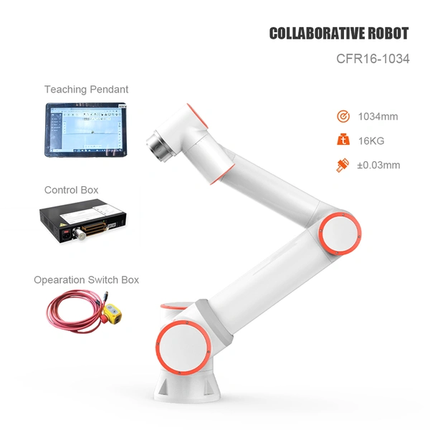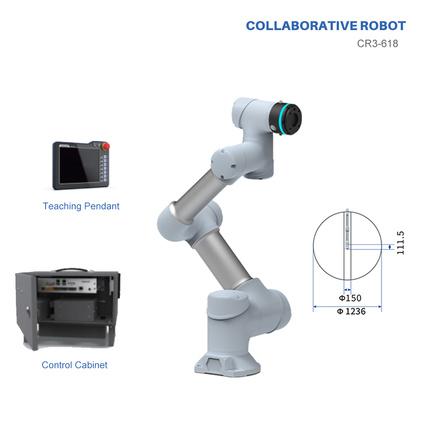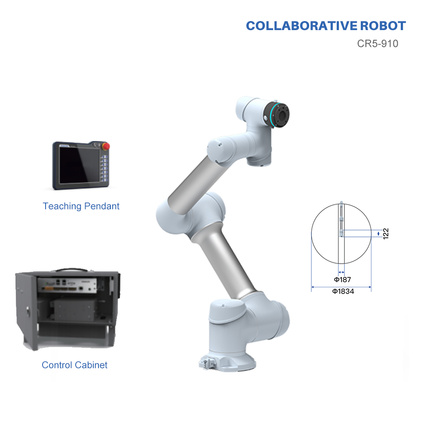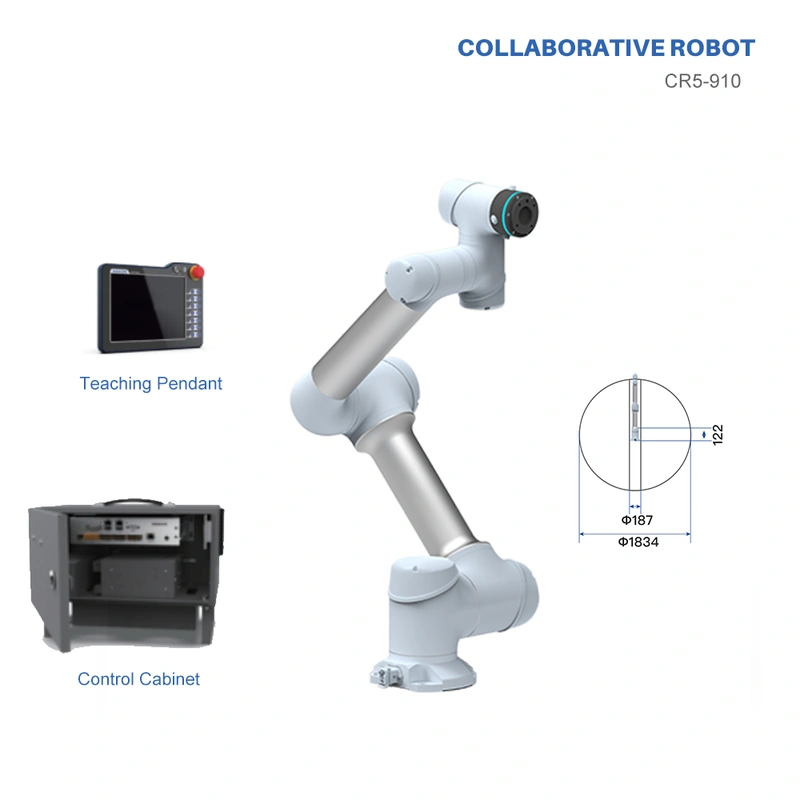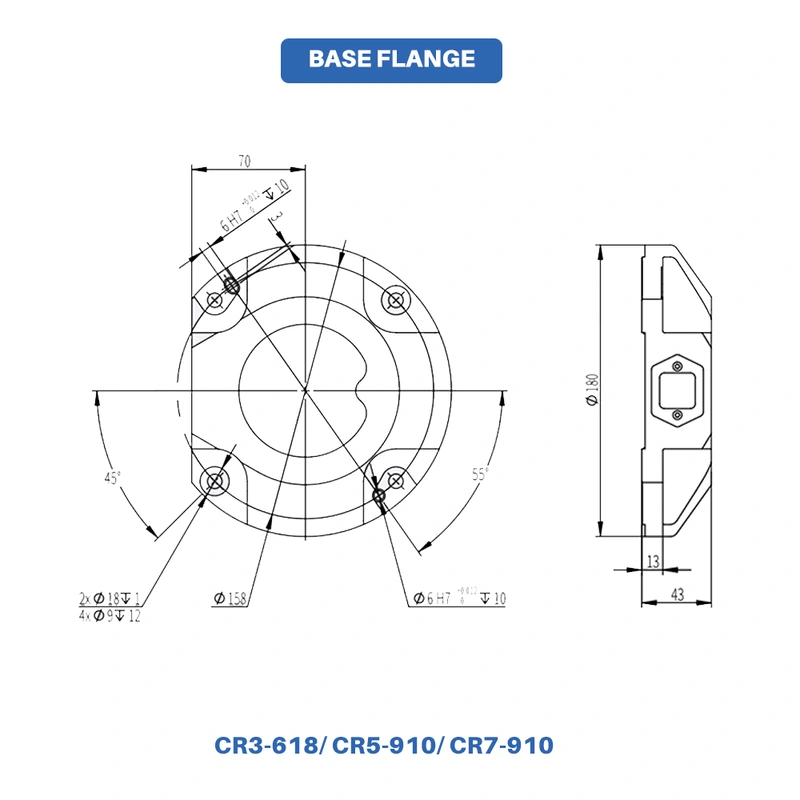















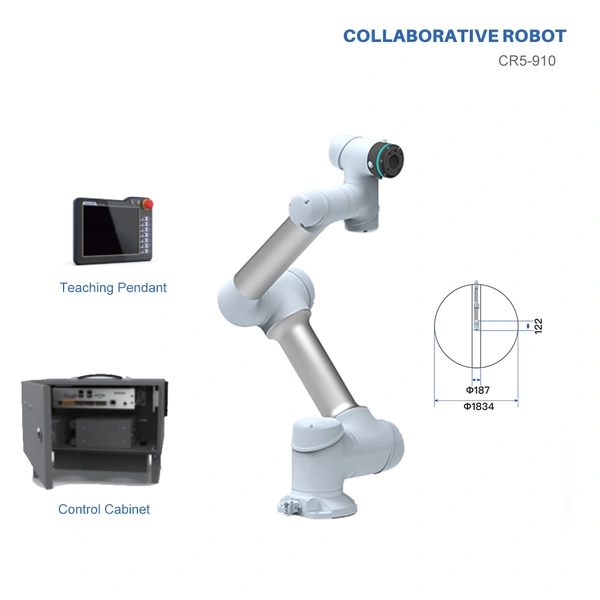
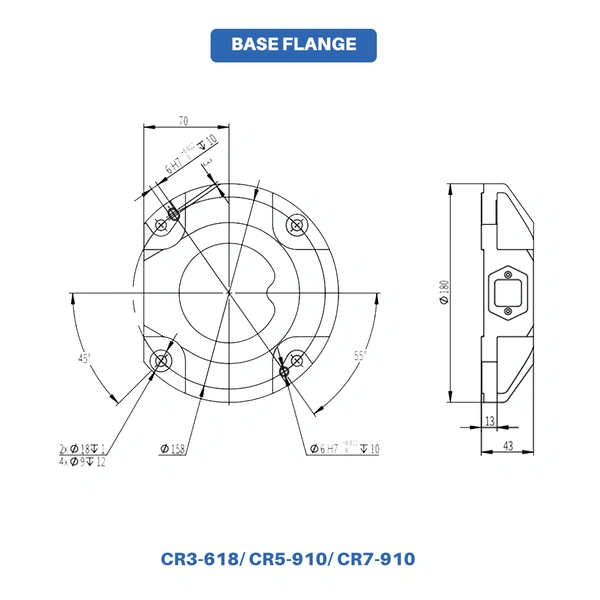



Collaborative robots are specifically designed to engage in direct, close-proximity interactions with humans within a shared workspace. This constitutes their fundamental distinction from traditional industrial robots: whereas traditional industrial robots must be physically isolated—typically behind safety fences—to ensure safety, collaborative robots can work side-by-side with human workers without the need for physical barriers.

| Name | CR Series Collaborative Robot | ||
| Specification | Model | CR5-910 | |
| Payload | 5kg | ||
| Reach | 917mm | ||
| Degrees of Freedom | 6 rotating joints | ||
| HMI | 10.4 inch teach pendant or mobile terminal Web APP | ||
| Movement | Repeatability | ±0.02mm | |
| Axis Movement | Working range | Max Speed | |
| 1 axis | ±360° | ±225°/s | |
| 2 axis | ±360° | ±225°/s | |
| 3 axis | ±360° | ±225°/s | |
| 4 axis | ±360° | ±225°/s | |
| 5 axis | ±360° | ±225°/s | |
| 6 axis | ±360° | ±225°/s | |
| MAX TCP speed | 3.6m/s | ||
| Max Staight-Line Speed | 1.5m/s | ||
| Features | IP Classification | IP54/IP65 | |
| Tool Interface | GB/T 14468.1-50-4-M6(eqv ISO 9409-1) | ||
| Power Supply | 220-240VAC 47-63Hz10A/100-200VAC 47-63Hz 16A | ||
| I/O Ports | 2 Dig I/O,24V,0.6A | ||
| Storage Temperature Range | -40℃-55℃ | ||
| Robot Dimensions | 1100x330x220mm | ||
| Machine Weight | 22kg | ||
| Power Consumption | Typical Power Consumption 200W | ||
| Installation | Ground-mounted, inverted, cantilevered. Installed in any Direction | ||
| Control Cabinet | Power Input | 200-240VAC,47-63HZ,10A 100-200VAC,47-63HZ,16A | |
| Rated Output Power | 48V@600W | ||
| Weight | 13.6KG | ||
| Working Temperature Range | -10-50℃ | ||
| Storage Temperature Range | -40-55℃ | ||
| Working humidity | 20%-70%RH | ||
| Storage humidity | 10%-95% (non-condensing) | ||
| Air Pressure | 70-106kPa | ||
| IP Classification | IP44 | ||
| Noise | ≤55db | ||
| Communication Interface | CAN、RS485、LAN、EtherCAT、INC Encoder signa lA+,A-;B+,B-;Z+,Z- | ||
| User interface | 16-channel DI (PNP type, L: -3V~5V, H: 11V-30VDC, 2~15mA), 16-channel DO (PNP type, 22~28V, Max: 0.5A) | ||
| Control Box | Screen Size | 10.4 inches | |
| Screen Resolution | 800*600/60Hz | ||
| Touchscreen Type | Capacitive | ||
| Operating Temperature Range | 0℃~50℃ | ||
| Operating Humidity Range | 10~90%RH (non-condensing) | ||
| Protection Rating | IP54 | ||
| Dimensions | 295*225*45 (excluding grip) | ||
| Weight | 1.3kg | ||

a. Power and Force Limiting: Built-in torque sensors monitor the torque at each joint in real time, allowing collision force thresholds to be configured below the biomechanical tolerance limits of the human body.
b. Safety-Rated Monitored Stop: Features integrated safety I/O interlocking capabilities.
c. Speed and Separation Monitoring: Enables real-time adjustment of motion speed via a safety PLC.
d. Repeatability: ±0.02 mm
e. Collaborative robots are ideally suited for flexible manufacturing environments characterized by high-mix, variable-batch production—such as laser marking of medical devices, precision assembly, and optical inspection. While maintaining industrial-grade repeatability, they provide a collaborative workspace between humans and machines that is unattainable with traditional robotic systems.
The application value of collaborative robots stems from their three key technical features: force control perception, visual guidance, and flexible deployment. Below, we analyze four core application directions from the perspective of technical implementation.
1. Precise Assembly and Force Control Insertion
In traditional rigid assembly, positional deviations can lead to jamming or damage to the workpiece. Collaborative robots adopt a torque control mode, allowing the end to promptly sense contact force and actively adapt. A typical application is the insertion of electronic connectors: The robot initially applies a force of 0.5N to search for the hole position. Upon detecting a sudden change in force, it automatically adjusts its posture to achieve a precise insertion with a gap of 0.1mm, resulting in a yield rate of up to 99.9%.
II. Adaptive Grinding and Polishing
The workpiece blank has a ±1mm dimensional tolerance. Traditional position control robots are difficult to adapt to this. Collaborative robots use a force/position hybrid control method to maintain a constant contact force between the end tool and the workpiece surface (with an accuracy of ±0.5N), automatically compensating for trajectory deviations. It is suitable for surface treatment of automotive parts, bathroom hardware, and other products.
III. Machine Vision Guided Grasping
The collaborative robot equipped with 2D/3D cameras achieves visual servoing through hand-eye calibration. A typical application is the sorting of scattered and stacked workpieces: the deep learning model identifies the position and orientation of the workpieces, and the robot plans the grasping trajectory in real time. No precise positioning of the tray is required. During production changeovers, only the visual model needs to be switched, and the programming time is compressed from several hours to minutes.
IV. Mobile Collaborative Composite Robot
The collaborative arm is mounted on the AMR chassis to form an integrated "hand-eye-foot" system. It is suitable for cross-workstation material handling and operation scenarios, such as in a machining production line: The AMR moves to the lathe, the mechanical arm grabs the blank and feeds it into the spindle, and after completion, the finished product is taken out and sent to the inspection station. Communication is achieved through 5G + OPC UA, with millisecond-level collaboration.
The above four directions represent the path through which collaborative robots evolve from "fixed workstation repetitive actions" to "environmental adaptability and diversified tasks".