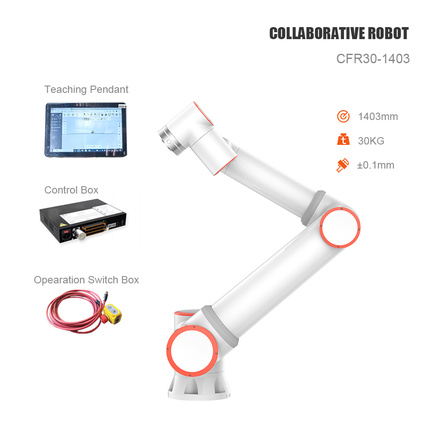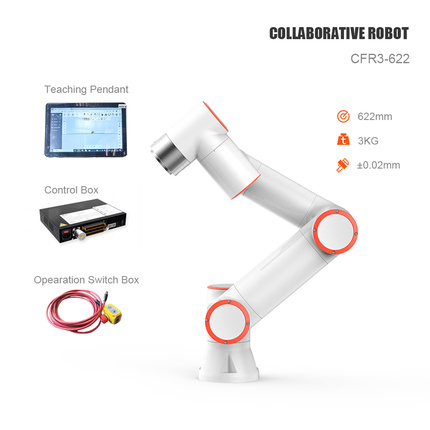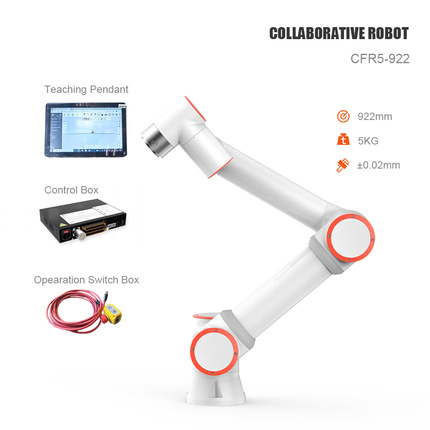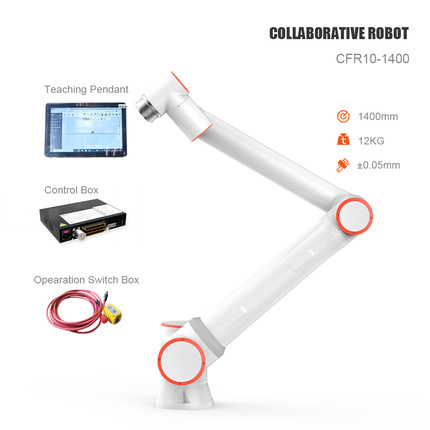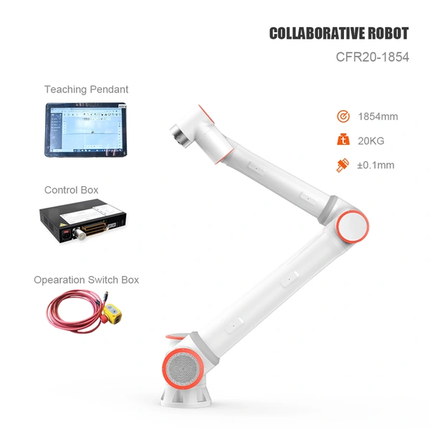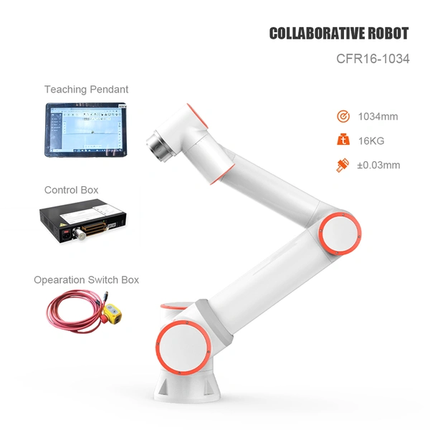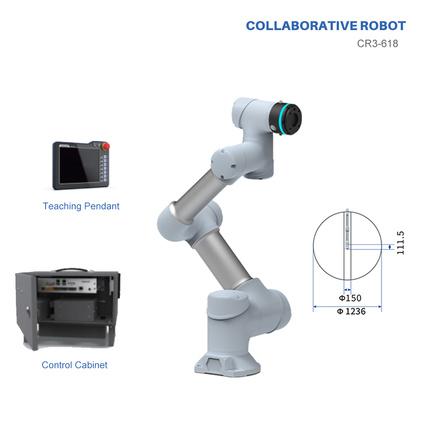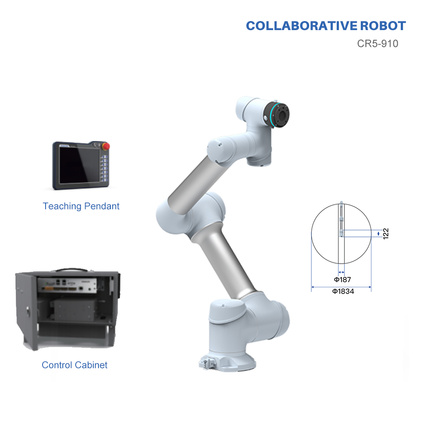


















Der grundlegende Unterschied zwischen kollaborativen Robotern und herkömmlichen Industrierobotern liegt nicht nur in ihrem Aussehen oder ihrer Tragfähigkeit, sondern vor allem in ihrer zugrundeliegenden Steuerungsarchitektur. Kollaborative Roboter nutzen Kraft-/Drehmoment-Regelkreise und gewährleisten so inhärente Sicherheit in Situationen, in denen Menschen und Roboter zusammenarbeiten.

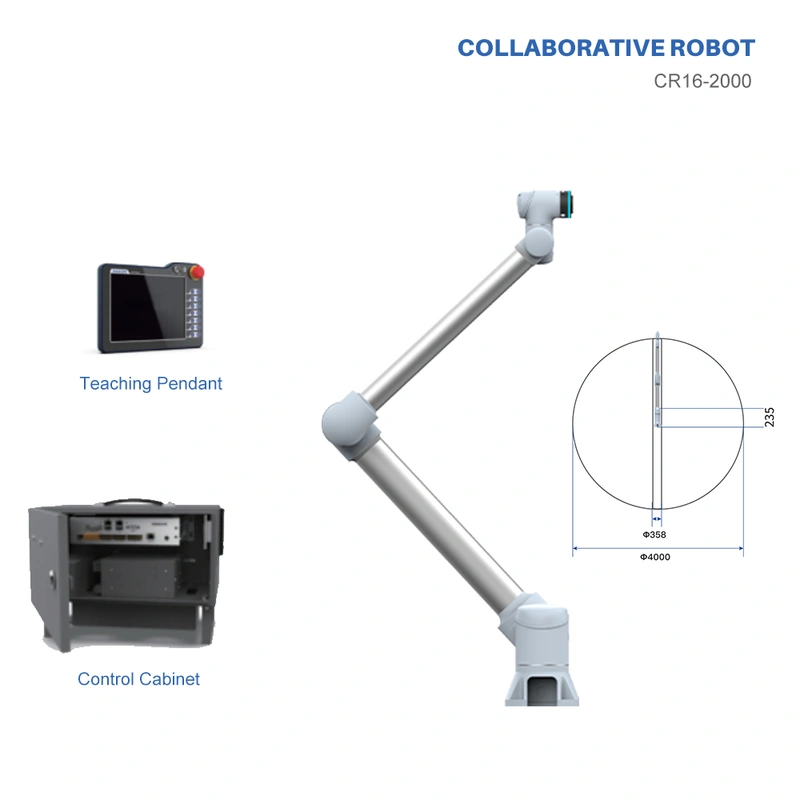
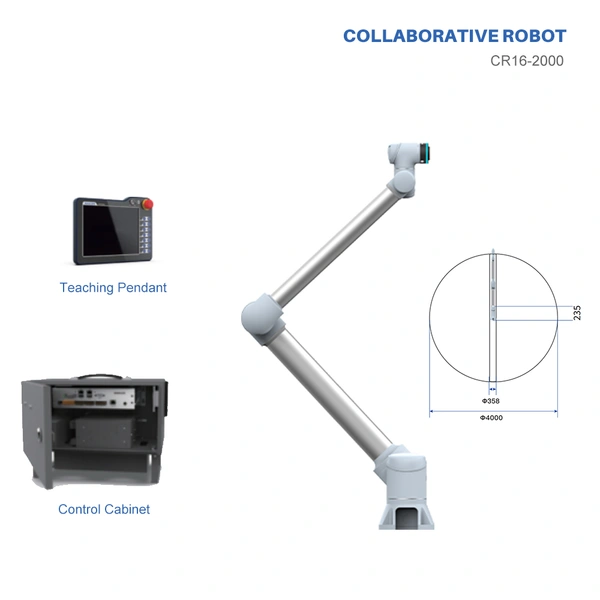
| Name | Kollaborativer Roboter der CR-Serie | ||
| Spezifikation | Modell | CR16-2000 | |
| Nutzlast | 16 kg | ||
| Erreichen | 2000 mm | ||
| Freiheitsgrade | 6 drehbare Gelenke | ||
| HMI | 10,4-Zoll-Teach-Pendant oder mobiles Terminal Web-App | ||
| Bewegung | Wiederholbarkeit | ±0,05 mm | |
| Achsenbewegung | Arbeitsbereich | Höchstgeschwindigkeit | |
| 1 Achse | ±360° | ±180°/s | |
| 2 Achsen | ±360° | ±180°/s | |
| 3 Achsen | ±360° | ±225°/s | |
| 4 Achsen | ±360° | ±225°/s | |
| 5 Achsen | ±360° | ±225°/s | |
| 6 Achsen | ±360° | ±225°/s | |
| Maximale TCP-Geschwindigkeit | 3,5 m/s | ||
| Höchstgeschwindigkeit auf gerader Strecke | 1,8 m/s | ||
| Merkmale | IP-Klassifizierung | IP54/IP65 | |
| Werkzeugschnittstelle | GB/T 14468.1-50-4-M6 (entspricht ISO 9409-1) | ||
| Stromversorgung | 220–240 V AC, 47–63 Hz, 10 A / 100–200 V AC, 47–63 Hz, 16 A | ||
| E/A-Anschlüsse | 2 digitale Ein-/Ausgänge, 24 V, 0,6 A | ||
| Lagertemperaturbereich | -40℃-55℃ | ||
| Roboterabmessungen | 2300 x 388 x 205 mm | ||
| Maschinengewicht | 60 kg | ||
| Stromverbrauch | Typischer Stromverbrauch: 600 W | ||
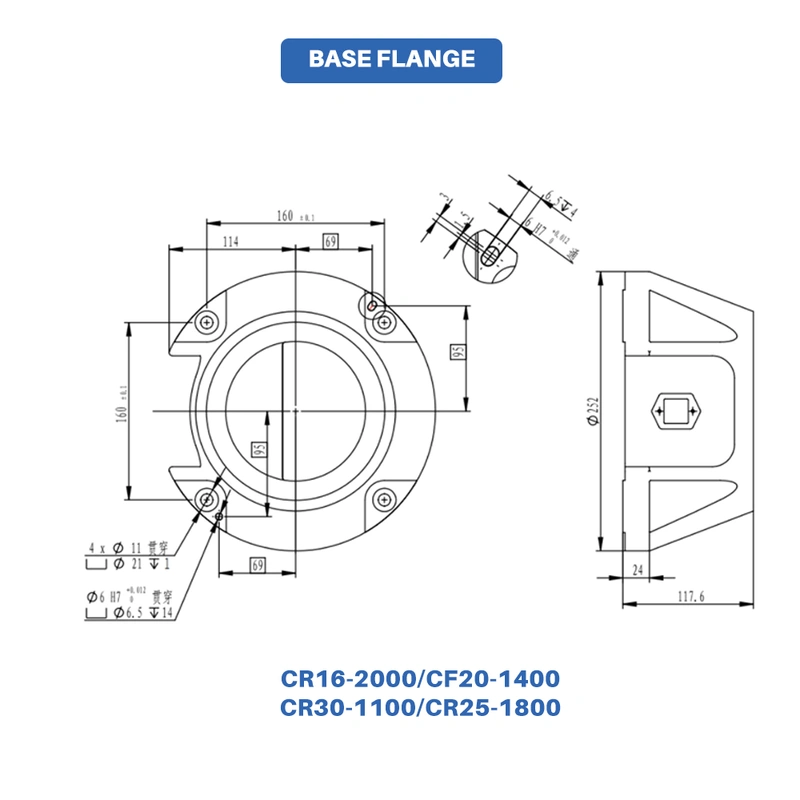
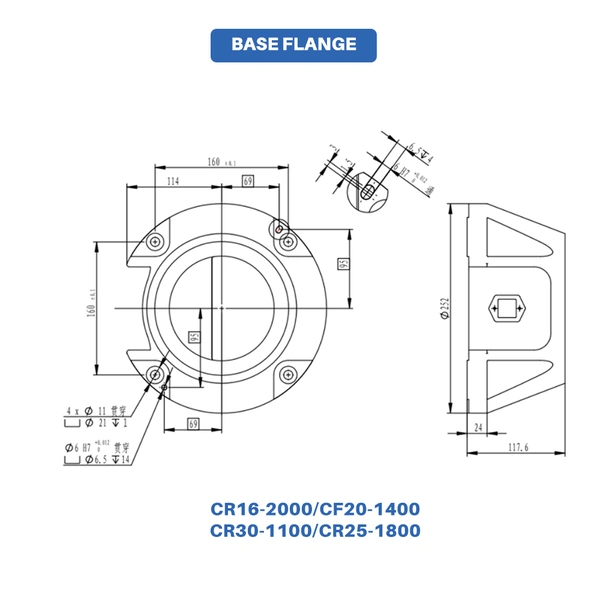
| Installation | Bodenmontiert, kopfüber, freitragend. Installation in jeder Richtung möglich. | ||
| Schaltschrank | Leistungsaufnahme | 200–240 V AC, 47–63 Hz, 10 A; 100–200 V AC, 47–63 Hz, 16 A | |
| Nennausgangsleistung | 48 V bei 600 W | ||
| Gewicht | 13,6 kg | ||
| Arbeitstemperaturbereich | -10-50℃ | ||
| Lagertemperaturbereich | -40-55℃ | ||
| Betriebsfeuchtigkeit | 20–70 % relative Luftfeuchtigkeit | ||
| Lagerfeuchtigkeit | 10%-95% (nicht kondensierend) | ||
| Luftdruck | 70-106 kPa | ||
| IP-Klassifizierung | IP44 | ||
| Lärm | ≤55 dB | ||
| Kommunikationsschnittstelle | CAN, RS485, LAN, EtherCAT, INC-Encoder-Signal lA+, A-; B+, B-; Z+, Z- | ||
| Benutzeroberfläche | 16-Kanal DI (PNP-Typ, L: -3V~5V, H: 11V-30VDC, 2~15mA), 16-Kanal DO (PNP-Typ, 22~28V, Max: 0,5A) | ||
| Kontrollkästchen | Bildschirmgröße | 10,4 Zoll | |
| Screen Resolution | 800*600/60Hz | ||
| Touchscreen Type | Capacitive | ||
| Operating Temperature Range | 0℃~50℃ | ||
| Operating Humidity Range | 10~90%RH (non-condensing) | ||
| Protection Rating | IP54 | ||
| Dimensions | 295*225*45 (excluding grip) | ||
| Weight | 1.3kg | ||

a. Power and Force Limiting: Built-in torque sensors monitor the torque at each joint in real time, allowing collision force thresholds to be configured below the biomechanical tolerance limits of the human body.
b. Safety-Rated Monitored Stop: Features integrated safety I/O interlocking capabilities.
c. Speed and Separation Monitoring: Enables real-time adjustment of motion speed via a safety PLC.
d. Repeatability: ±0.02 mm
e. Collaborative robots are ideally suited for flexible manufacturing environments characterized by high-mix, variable-batch production—such as laser marking of medical devices, precision assembly, and optical inspection. While maintaining industrial-grade repeatability, they provide a collaborative workspace between humans and machines that is unattainable with traditional robotic systems.
The application value of collaborative robots is based on three major technical pillars: torque control, visual guidance, and flexible deployment. Below, we will comprehensively analyze their application directions from a technical perspective.
I. Precision Assembly and Force Control Technology
Traditional rigid assembly has extremely high requirements for positional accuracy. Even a slight deviation can lead to damage. Collaborative robots adopt a force/position hybrid control method, where the end effector can immediately sense the contact force and actively adapt to it. Typical applications include insertion of electronic connectors and bearing press-fitting. The force control accuracy can reach ±0.5N, and the gap tolerance has been relaxed from 0.01mm to 0.1mm, significantly reducing the requirements for the positioning accuracy of the front end.
II. Surface Treatment and Adaptive Grinding
The workpiece blank has a ±1mm dimensional tolerance, which is difficult for traditional position control robots to handle. The collaborative robot maintains a constant contact force between the tool and the workpiece surface through constant force control, automatically compensates for trajectory deviations, and is suitable for scenarios such as grinding of car bumpers, polishing of bathroom hardware, and sanding of wood products.
III. Machine Vision Guidance and Zero-Teaching Grasping
The collaborative robot equipped with 2D/3D cameras achieves visual servoing through hand-eye calibration. The deep learning model can identify the pose of scattered and stacked workpieces and plan the grasping trajectory in real time. During product changeover, only the visual model needs to be switched, reducing the programming time from several hours to minutes. It can also be used for quality control tasks such as product appearance inspection, size measurement, and OCR character recognition.
IV. Mobile Collaborative Composite Robot
Der Roboterarm ist auf dem AMR-Chassis montiert und bildet ein integriertes „Hand-Auge-Fuß“-System. Er eignet sich für die materialübergreifende Handhabung und Bedienung an verschiedenen Arbeitsstationen, beispielsweise in automatisierten Fertigungslinien: Der AMR fährt zur CNC-Maschine, der Roboterarm greift das Werkstück und führt es in die Spindel ein. Nach der Bearbeitung wird das fertige Produkt entnommen und zur Prüfstation transportiert. Die Kommunikation erfolgt über 5G + OPC UA und ermöglicht so eine Zusammenarbeit im Millisekundenbereich.
V. Nachbearbeitung der Laserbearbeitung und additiven Fertigung
Die kollaborativen Roboter arbeiten mit den Laseranlagen zusammen, um Schneid-, Schweiß-, Markierungs- und Reinigungsvorgänge durchzuführen. In der Medizintechnik werden hochpräzise kollaborative Roboter zur Lasermarkierung von UDI-Codes eingesetzt; in der Nachbearbeitung von 3D-Drucken dienen sie dem Entfernen von Stützstrukturen und der Oberflächenbearbeitung.
VI. Palettieren, Entpalettieren und Verpacken
Die kollaborativen Roboter eignen sich für das Palettieren und Entpalettieren in verschiedenen Logistiklagern und am Ende von Produktionslinien. Sie können Kartons unterschiedlicher Größe automatisch erkennen und nach voreingestellten Mustern stapeln, wodurch das manuelle Heben schwerer Lasten entfällt und das Risiko von Arbeitsunfällen reduziert wird.
Die technologische Entwicklung kollaborativer Roboter von „wiederholten Aktionen an festen Positionen“ hin zu „Umgebungsanpassungsfähigkeit und vielfältigen Aufgaben“ hat es ihnen ermöglicht, verschiedene Anwendungsszenarien zu erfüllen und dadurch großen Komfort zu bieten.